

When people compare insurance companies, one number that often gets attention is the Claim Settlement Ratio (CSR). It is commonly used as an indicator of how many claims an insurer has settled during a particular period.
However, the Claim Settlement Ratio is only one part of understanding an insurer’s claim record. It should be viewed alongside other information such as claim amounts, claim types, policy terms, settlement time, and the nature of claims.
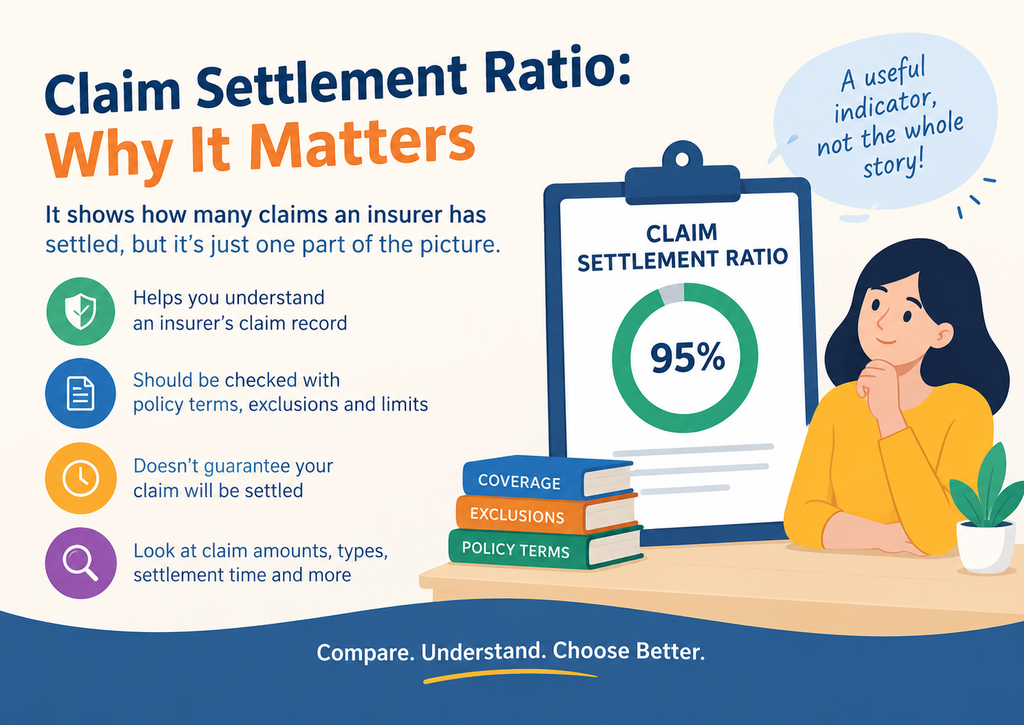
What Is Claim Settlement Ratio?
Claim Settlement Ratio generally represents the proportion of claims settled by an insurance company compared with the claims considered in the relevant calculation during a particular financial year.
For example, if an insurer receives or considers 1,000 claims and settles 950 of them under the methodology used for that reported ratio, the ratio may be expressed as 95%.
The exact methodology and reporting basis can vary, so the source and definition of the published figure are important.
Why Is Claim Settlement Ratio Important?
A Claim Settlement Ratio can provide policy buyers with an indication of an insurer’s claim settlement record.
It can be useful when researching insurance companies because claims are an important part of the insurance relationship. A policyholder ultimately expects the insurer to assess covered claims according to the terms of the policy.
However, the ratio should not be interpreted as a guarantee that an individual claim will be settled.
A High Ratio Does Not Mean Every Claim Will Be Paid
Claim settlement depends on the individual policy and circumstances of the claim.
Factors such as:
- Policy coverage
- Exclusions
- Policy conditions
- Documentation
- Claim circumstances
- Sum insured and applicable limits
- Deductibles or other applicable provisions
can affect an individual claim.
Therefore, a company’s reported Claim Settlement Ratio cannot by itself determine whether a particular future claim will be payable.
Claim Count and Claim Amount Are Different
One important point when looking at claim statistics is the difference between number of claims and amount of claims.
A settlement ratio based on the number of claims does not necessarily tell you how much money was paid in those claims.
For example, an insurer could settle a large number of relatively small claims while a smaller number of high-value claims may involve substantially larger amounts.
This is why looking only at the percentage can provide an incomplete picture.
Claim Settlement Ratio Can Change Every Year
Insurance companies handle different numbers and types of claims every year.
As a result, the Claim Settlement Ratio can change from one financial year to another.
When comparing figures, it is useful to check the relevant financial year and use information from reliable and current sources rather than relying on an old percentage.
Claim Settlement Ratio Is Not the Same as Claim Settlement Time
The Claim Settlement Ratio tells you about the proportion of claims settled according to the relevant calculation.
It does not necessarily tell you how quickly those claims were settled.
Two insurers could have similar settlement ratios while having different claim-processing timelines.
Therefore, claim settlement time and the settlement ratio should be considered as separate aspects.
The Type of Insurance Also Matters
Claim patterns can differ significantly between insurance products.
Life insurance, health insurance, motor insurance, property insurance, travel insurance, and commercial insurance involve different types of risks and claims.
For this reason, comparing a Claim Settlement Ratio without considering the type of insurance may provide limited information.
Why Policy Terms Still Matter
Even when an insurer has a strong historical claim settlement record, the policyholder’s coverage is ultimately governed by the policy contract.
Important details include:
- Coverage
- Exclusions
- Waiting periods, where applicable
- Policy limits
- Deductibles
- Conditions
- Definitions
- Applicable endorsements
Understanding these provisions can be more directly relevant to an individual claim than relying on a company’s overall settlement percentage.
Claim Settlement Ratio and Policy Buying Decisions
Claim Settlement Ratio can be one useful piece of information when researching an insurer.
A broader comparison may also consider the policy’s coverage, premium, exclusions, benefits, service features, claim-related information, financial information, and other relevant factors.
No single statistic can fully describe the experience of every policyholder.
What Happens When a Claim Is Rejected?
A company’s Claim Settlement Ratio does not mean that every rejected claim is automatically justified or that every rejected claim is automatically incorrect.
If a claim is rejected, the specific reasons provided by the insurer and the applicable policy terms are important for understanding the decision.
Similarly, a short-settled or delayed claim needs to be considered based on its individual facts and the terms of the policy.
Final Thoughts
The Claim Settlement Ratio can be a useful statistic for understanding an insurer’s historical claim settlement record. However, it should be viewed in context.
The percentage alone does not explain the size of claims, reasons for claim decisions, settlement timelines, policy exclusions, or the circumstances of individual claims.
For policyholders, understanding the actual policy terms and coverage remains essential. Claim Settlement Ratio is best treated as one piece of information rather than the complete picture of an insurance company’s claim performance.
Need Help With an Insurance Concern?
Insurance Resolve helps policyholders understand and address concerns related to claim rejection, claim delays, short settlement, insurance mis-selling, and service issues.
Website: www.insuranceresolve.com
Email: help@insuranceresolve.com
Phone: +91 9910352249

