
Motor insurance is a type of insurance that provides financial protection against certain risks associated with vehicles. It can protect vehicle owners against financial losses arising from accidents, theft, damage, and certain third-party liabilities, depending on the type of policy and its coverage.
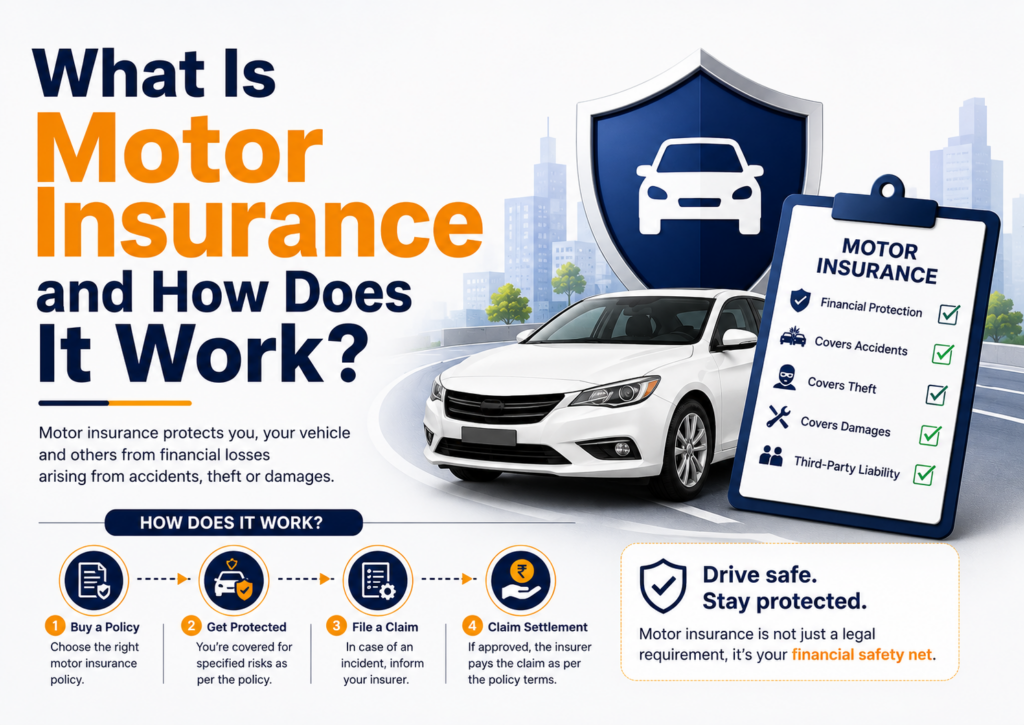
In India, motor insurance is an important part of vehicle ownership. The coverage available depends on the insurance policy, the vehicle, and the terms and conditions specified by the insurer.
What Is Motor Insurance?
Motor insurance is an insurance contract between a vehicle owner and an insurance company. Under the policy, the insurer provides specified financial protection against covered risks in exchange for a premium paid by the policyholder.
Motor insurance can apply to different types of vehicles, including:
- Cars
- Two-wheelers
- Commercial vehicles
- Other eligible motor vehicles
The coverage and benefits vary according to the type of motor insurance policy.
How Does Motor Insurance Work?
Motor insurance works on the principle of financial protection against specified risks.
The policyholder pays a premium to the insurer in return for coverage described in the policy. If an insured event occurs during the policy period, the policyholder may be entitled to claim benefits according to the applicable policy terms.
The insurer assesses the circumstances of the incident, the applicable coverage, policy conditions, exclusions, and the extent of the loss before determining the amount payable.
Types of Motor Insurance
Motor insurance in India is generally available in different forms.
Third-Party Motor Insurance
Third-party insurance provides coverage for certain legal liabilities arising from injury, death, or property damage caused to a third party by the insured vehicle, subject to the applicable terms and legal requirements.
Third-party motor insurance is an important component of motor vehicle insurance in India.
Comprehensive Motor Insurance
A comprehensive motor insurance policy generally provides broader protection than third-party-only coverage.
Depending on the policy, it may include protection against damage to the insured vehicle as well as third-party liabilities. Coverage may include risks such as accidents, theft, fire, natural events, and other specified situations.
The exact coverage depends on the policy wording.
Own Damage Insurance
Own-damage coverage is designed to protect the insured vehicle against specified risks. It can be particularly relevant for vehicle damage resulting from covered accidents or other insured events.
The availability and conditions of own-damage coverage depend on the insurance product.
What Does Motor Insurance Cover?
Motor insurance coverage varies according to the policy. Depending on the type of insurance, coverage may include:
- Accidental damage to the insured vehicle.
- Theft of the insured vehicle.
- Fire-related damage.
- Certain natural calamities.
- Certain man-made events.
- Third-party liability.
- Damage caused to third-party property.
- Other specified risks mentioned in the policy.
Not every event or type of damage is automatically covered.
What Is Not Covered by Motor Insurance?
Motor insurance policies also contain exclusions. Common exclusions may include certain situations such as:
- Normal wear and tear.
- Mechanical or electrical breakdowns not covered by the policy.
- Driving without a valid licence.
- Driving under certain prohibited conditions.
- Damage occurring outside the applicable policy coverage.
- Certain consequential losses.
- Intentional damage.
The exact exclusions depend on the specific policy and its terms.
What Is the Role of the Motor Insurance Premium?
The premium is the amount paid by the policyholder for the insurance coverage.
The cost of motor insurance can depend on various factors, including the type of vehicle, vehicle value, location, coverage selected, policy features, claims history, and other applicable factors.
The premium may therefore differ from one vehicle or policyholder to another.
What Is IDV in Motor Insurance?
IDV, or Insured Declared Value, is an important concept in motor insurance, particularly in relation to comprehensive and own-damage coverage.
It generally represents the approximate insured value of the vehicle for certain claim-related purposes, subject to the policy terms and applicable depreciation.
IDV can be relevant when determining the insurer’s liability in situations such as total loss or theft.
What Is a No Claim Bonus?
A No Claim Bonus (NCB) is a benefit that may be available to eligible policyholders who do not make certain claims during the applicable policy period.
NCB is generally associated with own-damage motor insurance and may provide a discount on the own-damage premium at renewal, subject to applicable conditions.
Motor Insurance Claims
When a covered incident occurs, the policyholder may make a claim according to the insurance company’s applicable claim process.
The insurer may assess the incident, inspect the vehicle where necessary, review supporting documents, determine the extent of covered damage, and calculate the payable amount according to the policy.
The final settlement can be affected by deductibles, depreciation, exclusions, policy limits, and other applicable conditions.
Why Motor Insurance Claims May Be Rejected or Partially Settled
A motor insurance claim may not always be paid for the full amount claimed.
A claim can be affected by factors such as:
- Policy exclusions.
- Deductibles.
- Depreciation.
- Policy limits.
- Incomplete or inconsistent information.
- Violation of policy conditions.
- Damage that is not covered.
- Lack of applicable coverage.
A partially settled claim means that the insurer accepts liability but pays less than the amount claimed. A rejected claim means that the insurer declines the claim.
Importance of Understanding Motor Insurance Terms
Motor insurance policies contain important information regarding coverage, exclusions, deductibles, IDV, conditions, claim requirements, and limitations.
Understanding these terms provides policyholders with a clearer picture of the protection available under their policy and the circumstances in which the insurer may be responsible for a loss.
Insurance Resolve – Motor Insurance Claim & Complaint Support
Insurance Resolve helps policyholders understand various insurance-related concerns, including motor insurance claim rejection, claim delays, short-settled claims, insurance mis-selling, policy servicing issues, lapsed policies, and other insurance problems.
The objective is to provide greater clarity regarding insurance policies, claim decisions, and insurance-related concerns.
📞 Phone: +91 99103 52249
📧 Email: help@insuranceresolve.com
🌐 Website: www.insuranceresolve.com
Frequently Asked Questions (FAQs)
1. What is motor insurance?
Motor insurance is a contract that provides financial protection against specified risks involving a vehicle, subject to the policy’s coverage, conditions, exclusions, and limits.
2. Is motor insurance mandatory in India?
Third-party motor insurance is legally required for vehicles operating on Indian roads, subject to applicable laws and regulations.
3. What is the difference between third-party and comprehensive motor insurance?
Third-party insurance primarily covers specified liabilities toward third parties. Comprehensive insurance generally provides broader protection that may include damage to the insured vehicle along with third-party liability, depending on the policy.
4. What does comprehensive motor insurance cover?
Coverage varies by policy but may include accidental damage, theft, fire, certain natural calamities, specified man-made events, and third-party liabilities.
5. What is IDV in motor insurance?
IDV stands for Insured Declared Value. It represents the insured value of the vehicle used for certain claim-related purposes, subject to the policy terms.
6. What is No Claim Bonus in motor insurance?
No Claim Bonus is a benefit that may provide an eligible policyholder with a discount on the applicable own-damage premium after a claim-free policy period, subject to the relevant conditions.
7. Can a motor insurance claim be partially settled?
Yes. A claim may be partially settled when certain deductions, exclusions, depreciation, deductibles, limits, or other policy conditions affect the amount payable.
8. Can a motor insurance claim be rejected?
Yes. A claim may be rejected when the circumstances do not fall within the policy coverage or when applicable exclusions or policy conditions affect claim eligibility.
9. Does motor insurance cover normal wear and tear?
Generally, normal wear and tear is not covered as an insured accidental loss. The exact position depends on the policy wording.
10. Can Insurance Resolve help with motor insurance claim issues?
Insurance Resolve assists policyholders in understanding insurance-related concerns, including motor insurance claim rejection, claim delays, partial settlements, mis-selling, and service-related issues.
11. How can I contact Insurance Resolve?
📞 Phone: +91 99103 52249
📧 Email: help@insuranceresolve.com
🌐 Website: www.insuranceresolve.com
Conclusion
Motor insurance provides financial protection against specified risks associated with vehicles. Third-party, comprehensive, and own-damage insurance provide different levels of protection, while policy terms determine the actual coverage available.
Understanding concepts such as coverage, exclusions, IDV, deductibles, No Claim Bonus, claim settlement, and policy conditions can help vehicle owners better understand the protection provided by their motor insurance policy.

