
Commercial insurance is a type of insurance designed to provide financial protection to businesses against various risks that can affect their property, employees, operations, customers, and financial interests.
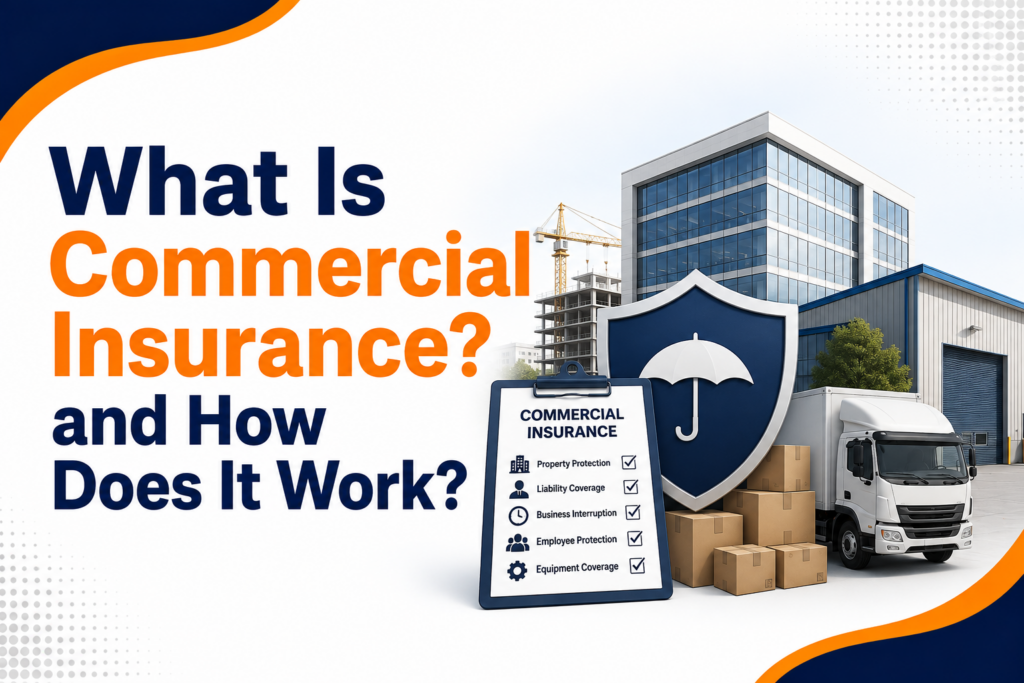
Businesses face different types of risks depending on their industry, size, location, assets, and activities. Commercial insurance can help protect a business from specified financial losses arising from covered events.
The type and extent of protection depend on the insurance policy, coverage selected, limits, exclusions, and applicable terms and conditions.
What Is Commercial Insurance?
Commercial insurance is insurance designed specifically for businesses and commercial activities.
It can provide protection against risks such as property damage, business interruption, liability claims, employee-related risks, equipment damage, theft, fire, and other specified risks.
A business pays a premium to an insurance company in return for the coverage described in the policy.
How Does Commercial Insurance Work?
Commercial insurance works by providing financial protection against risks covered under the insurance policy.
When a covered event causes a financial loss, the business may make a claim under the applicable policy. The insurer evaluates the circumstances, reviews the available evidence and documents, determines whether the loss falls within the policy coverage, and calculates the payable amount according to the policy terms.
The final settlement can depend on factors such as policy limits, deductibles, exclusions, valuation, actual loss, and other applicable conditions.
Why Do Businesses Need Commercial Insurance?
Businesses can face unexpected financial losses from events such as fire, theft, accidents, property damage, lawsuits, natural disasters, equipment failure, and other risks.
Commercial insurance can provide financial protection against specified risks and help businesses manage the potential financial consequences of covered events.
The importance of a particular type of commercial insurance depends on the nature of the business and the risks associated with its operations.
Common Types of Commercial Insurance
Commercial insurance is a broad category that includes different types of business insurance.
Commercial Property Insurance
Commercial property insurance provides protection for business premises and specified business assets against covered risks.
Depending on the policy, it may cover buildings, furniture, machinery, equipment, stock, and other commercial property.
Fire Insurance
Fire insurance provides protection against fire and other specified insured perils.
It can be relevant to shops, offices, factories, warehouses, commercial buildings, machinery, and stock, depending on the policy.
Marine Insurance
Marine insurance can protect goods and cargo against specified risks during transportation.
It can be particularly relevant to importers, exporters, manufacturers, traders, and logistics businesses.
Business Interruption Insurance
Business interruption insurance can provide financial protection for certain losses arising from interruption of business operations following an insured event.
Depending on the policy, it may relate to loss of income, continuing expenses, or other specified financial losses.
Liability Insurance
Liability insurance can protect businesses against certain legal liabilities arising from claims made by third parties.
Different liability insurance products exist for different business activities and risks.
Professional Indemnity Insurance
Professional indemnity insurance is designed for certain professionals who may face claims relating to professional services, advice, errors, omissions, or negligence, subject to the policy terms.
Product Liability Insurance
Product liability insurance can provide protection against certain liabilities arising from products supplied or manufactured by a business.
The coverage depends on the nature of the product, business activity, and policy conditions.
Employee-Related Insurance
Certain commercial insurance products provide protection relating to employees and workplace-related risks.
The type of coverage depends on applicable laws, business requirements, and the specific insurance product.
Machinery and Equipment Insurance
Businesses that depend heavily on machinery and equipment may require insurance protection against specified damage or breakdown risks.
The coverage depends on the policy and the type of machinery insured.
What Can Commercial Insurance Cover?
Depending on the policy, commercial insurance may provide protection for:
- Business buildings
- Office equipment
- Machinery
- Stock and inventory
- Furniture and fixtures
- Goods in transit
- Business interruption
- Third-party liabilities
- Professional liabilities
- Product-related liabilities
- Employee-related risks
- Other specified business risks
Not every commercial insurance policy covers all these risks. Coverage depends on the particular policy selected.
What Is Not Covered by Commercial Insurance?
Commercial insurance policies contain exclusions and limitations.
Depending on the policy, exclusions may include:
- Intentional damage
- Normal wear and tear
- Certain illegal activities
- Uninsured property
- Certain contractual liabilities
- Losses outside the policy coverage
- Certain consequential losses
- Specific excluded events
- Other exclusions mentioned in the policy
The exact exclusions vary according to the insurance product.
Commercial Insurance and Business Size
Commercial insurance is relevant to businesses of different sizes.
A small retail shop may require protection for its premises, stock, equipment, and liabilities, while a large manufacturing company may require more extensive coverage for factories, machinery, inventory, transportation, employees, and operational risks.
The appropriate insurance requirements therefore depend on the nature and scale of the business.
Commercial Insurance Claims
When a covered event causes a business loss, the insured business may submit a claim to the insurer.
The insurer may review:
- The circumstances of the incident.
- Policy coverage.
- Business records.
- Invoices and financial documents.
- Repair estimates.
- Loss assessments.
- Property records.
- Other supporting evidence.
The insurer then determines whether the claim is payable and, where applicable, calculates the settlement amount according to the policy.
Why Commercial Insurance Claims May Be Rejected
A commercial insurance claim may be rejected when the reported loss is outside the policy coverage or an exclusion or policy condition applies.
Possible factors include:
- The risk is not covered.
- The property or activity was not insured.
- An exclusion applies.
- The policy was inactive.
- Required conditions were not satisfied.
- The claimed loss is not adequately supported.
- The circumstances do not match the insured event.
The actual reason depends on the individual policy and claim circumstances.
Why Commercial Insurance Claims May Be Partially Settled
A commercial insurance claim may sometimes be settled for less than the amount claimed.
Possible reasons include:
- Policy limits.
- Deductibles.
- Underinsurance.
- Depreciation.
- Exclusions.
- Non-covered expenses.
- Valuation differences.
- Assessment of actual loss.
- Other policy conditions.
A partial settlement means that some amount has been accepted as payable, rather than the entire claim being rejected.
Importance of Policy Limits
Commercial insurance policies generally contain specific limits for different types of coverage.
A business may have several assets and liabilities, but the insurer’s responsibility is limited according to the applicable coverage and policy limits.
Understanding these limits is important when considering the extent of financial protection provided by commercial insurance.
Commercial Insurance and Risk Management
Insurance is one part of broader business risk management.
Businesses may face risks that cannot be completely eliminated through insurance. Commercial insurance provides financial protection against specified insured risks, while other business controls may be required to manage operational, financial, safety, and other risks.
Insurance Resolve – Commercial Insurance Claim & Complaint Solutions
Insurance Resolve helps policyholders and businesses understand insurance-related concerns, including commercial insurance claim rejection, claim delays, short-settled claims, fire insurance issues, marine insurance concerns, insurance mis-selling, policy servicing problems, and other insurance matters.
The objective is to provide greater clarity regarding insurance policies, claim decisions, and insurance-related concerns.
📞 Phone: +91 99103 52249
📧 Email: help@insuranceresolve.com
🌐 Website: www.insuranceresolve.com
Frequently Asked Questions (FAQs)
1. What is commercial insurance?
Commercial insurance is insurance designed to protect businesses against specified risks that may cause financial loss or liability.
2. What does commercial insurance cover?
Depending on the policy, commercial insurance may cover business property, machinery, stock, liabilities, goods in transit, business interruption, professional risks, and other specified risks.
3. What types of businesses can have commercial insurance?
Businesses of different sizes and industries can have commercial insurance. The type of coverage depends on the business’s activities, assets, location, and risks.
4. Is commercial property insurance different from commercial insurance?
Commercial insurance is a broad category that can include commercial property insurance along with liability, marine, business interruption, professional, and other types of business insurance.
5. Can commercial insurance cover business property?
Yes. Commercial property insurance can provide protection for specified business buildings, machinery, equipment, stock, furniture, and other assets.
6. Can commercial insurance cover business interruption?
Certain commercial policies can provide business interruption coverage for specified financial losses resulting from covered events, subject to policy conditions.
7. Can a commercial insurance claim be rejected?
Yes. A claim may be rejected when the loss is outside the policy coverage, an exclusion applies, or applicable policy conditions are not satisfied.
8. Can a commercial insurance claim be partially settled?
Yes. Partial settlements can result from policy limits, deductibles, underinsurance, depreciation, exclusions, valuation differences, or other applicable conditions.
9. Why are policy limits important in commercial insurance?
Policy limits determine the maximum amount the insurer may be responsible for under particular coverage, subject to the policy terms and conditions.
10. Does every business need the same commercial insurance?
No. Insurance requirements vary according to the business’s industry, assets, operations, location, employees, customers, and associated risks.
11. Can Insurance Resolve help with commercial insurance concerns?
Insurance Resolve assists businesses and policyholders in understanding concerns related to commercial insurance claims, claim rejection, delays, partial settlements, mis-selling, and service-related issues.
Conclusion
Commercial insurance provides businesses with financial protection against specified risks that can affect their property, operations, liabilities, employees, and other financial interests.
It can include different forms of coverage such as commercial property insurance, fire insurance, marine insurance, liability insurance, business interruption insurance, professional indemnity insurance, and other specialised products.
The actual protection depends on the specific policy, coverage limits, exclusions, deductibles, insured risks, and applicable conditions. Understanding these provisions provides businesses with greater clarity about the protection offered by their commercial insurance.

