
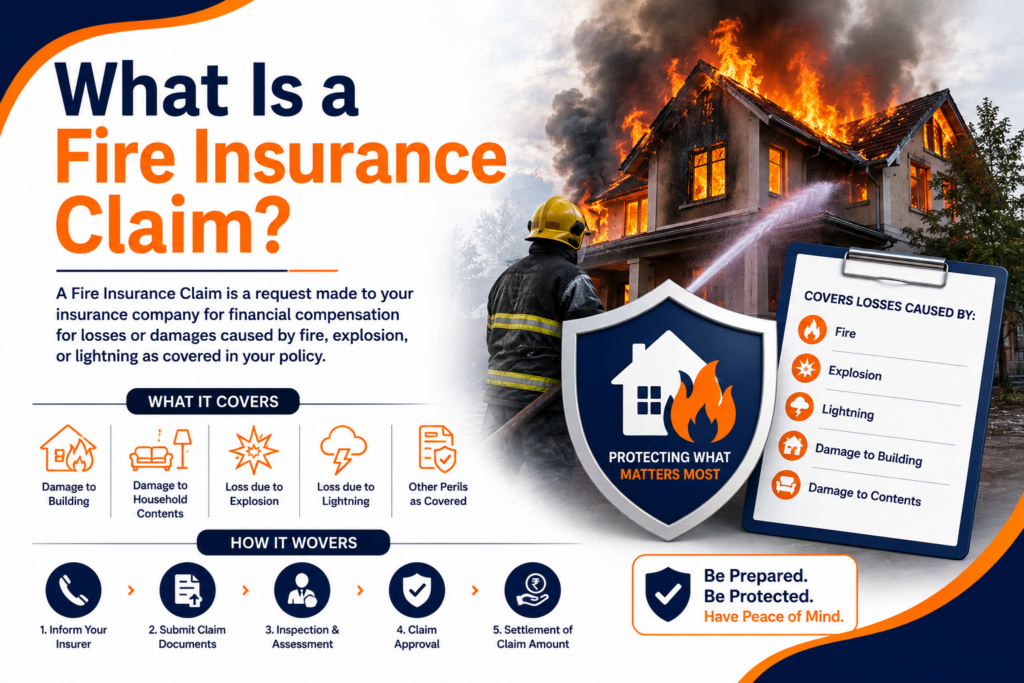
A fire insurance claim is a request made by a policyholder to an insurance company for financial compensation after insured property suffers loss or damage due to a covered fire-related event.
Fire insurance can provide financial protection for buildings, machinery, stock, furniture, equipment, and other insured property, depending on the policy. When a covered fire causes damage, the policyholder may have a right to claim compensation according to the terms and conditions of the insurance policy.
The amount payable depends on factors such as the extent of the loss, policy coverage, exclusions, deductibles, valuation, and applicable policy limits.
What Does a Fire Insurance Claim Mean?
A fire insurance claim represents a financial claim for a loss covered under a fire insurance policy.
For example, if a commercial building, warehouse, machinery, or insured stock is damaged by a covered fire, the policyholder may have a claim under the applicable insurance policy.
The insurer evaluates the circumstances of the incident and determines whether the loss falls within the policy coverage.
What Can Fire Insurance Cover?
Depending on the policy, fire insurance may provide protection against certain losses caused by covered events.
Insured property may include:
- Buildings and structures
- Machinery and equipment
- Furniture and fixtures
- Stock and inventory
- Electrical installations
- Business contents
- Other specified assets
The actual coverage depends on the policy wording and the property declared for insurance.
Types of Losses in a Fire Insurance Claim
A fire can result in different types of financial losses.
Property Damage
Fire can directly damage or destroy buildings, machinery, equipment, furniture, stock, and other insured property.
Smoke and Heat Damage
Property can sometimes be damaged by smoke, heat, or related effects even when it is not directly consumed by flames, subject to the policy coverage.
Water or Firefighting Damage
Firefighting activities can sometimes cause additional damage to insured property. Whether such damage is covered depends on the policy terms and circumstances.
Business-Related Losses
Some commercial insurance policies may provide additional protection for business interruption or related financial losses, where specifically covered.
What Is Usually Not Covered?
Fire insurance does not necessarily cover every type of fire-related loss.
Policies can contain exclusions relating to certain causes, circumstances, property, or types of loss.
Common limitations may involve:
- Intentional damage
- Certain excluded risks
- Uninsured property
- Losses outside the policy period
- Policy conditions that have not been satisfied
- Certain consequential losses
- Other exclusions mentioned in the policy
The exact exclusions vary between insurance policies.
Fire Insurance Claim and Policy Coverage
The existence of a fire does not automatically mean that every resulting loss is payable.
The insurer considers whether:
- The affected property was insured.
- The policy was active when the incident occurred.
- The cause of the fire falls within the covered risks.
- Any exclusion applies.
- The claimed loss falls within the policy limits.
- Other relevant policy conditions are satisfied.
This is why the actual policy wording is important when understanding a fire insurance claim.
Fire Insurance Claim Rejection
A fire insurance claim may be rejected when the insurer determines that the reported loss is outside the policy coverage or an applicable exclusion or condition prevents payment.
Possible concerns can include:
- The cause of loss is excluded.
- The damaged property was not insured.
- The policy was not active.
- The loss does not match the insured risk.
- Material information was not properly disclosed.
- Applicable policy conditions were not satisfied.
The exact reason for rejection depends on the individual policy and circumstances.
Fire Insurance Claim and Partial Settlement
A fire claim does not always result in either complete approval or complete rejection.
An insurer may accept liability for part of the loss and settle an amount lower than the total amount claimed.
This can happen because of:
- Policy limits
- Deductibles
- Depreciation
- Valuation differences
- Underinsurance
- Exclusions
- Non-covered property
- Other policy conditions
Such an outcome is generally referred to as a partial or short settlement.
Importance of Valuation in Fire Insurance Claims
Valuation can play an important role in determining the amount payable under a fire insurance policy.
The value of damaged or destroyed property may be assessed using applicable valuation methods and policy provisions.
Factors such as depreciation, replacement cost, market value, reinstatement value, and policy-specific valuation conditions can influence the claim amount.
Fire Insurance for Businesses
Fire insurance is particularly important for businesses because a major fire can affect both physical assets and business operations.
A commercial fire insurance policy may cover specified property such as:
- Buildings
- Machinery
- Raw materials
- Finished goods
- Stock
- Furniture
- Equipment
Some policies may also provide additional coverage for business interruption or related losses if specifically included.
Insurance Resolve – Fire Insurance Claim Solutions
Insurance Resolve helps policyholders understand insurance concerns including fire insurance claim rejection, claim delays, short-settled claims, policy disputes, insurance mis-selling, service issues, and other insurance problems.
The objective is to provide greater clarity regarding insurance policies, claim decisions, and insurance-related concerns.
📞 Phone: +91 99103 52249
📧 Email: help@insuranceresolve.com
🌐 Website: www.insuranceresolve.com
Frequently Asked Questions (FAQs)
1. What is a fire insurance claim?
A fire insurance claim is a request for compensation from an insurer when insured property suffers covered loss or damage due to a fire-related event.
2. What does fire insurance cover?
Depending on the policy, fire insurance can cover specified buildings, machinery, stock, equipment, furniture, and other insured property against covered risks.
3. Does fire insurance cover smoke damage?
Smoke damage may be covered when it falls within the applicable policy coverage. The exact terms depend on the insurance policy.
4. Can a fire insurance claim be rejected?
Yes. A claim can be rejected if the loss is excluded, the property is not covered, the policy was inactive, or other applicable policy conditions affect coverage.
5. Can a fire insurance claim be partially settled?
Yes. A claim may be partially settled because of deductibles, depreciation, policy limits, valuation differences, underinsurance, exclusions, or other policy conditions.
6. Does fire insurance cover business interruption?
Some commercial policies provide business interruption coverage, but it is generally subject to specific policy terms and may not be included in every fire insurance policy.
7. Is every fire-related loss covered by insurance?
No. Fire insurance coverage depends on the insured risks, exclusions, policy limits, conditions, and the specific circumstances of the loss.
Conclusion
A fire insurance claim provides a mechanism for seeking financial compensation when insured property suffers loss or damage due to a covered fire-related event.
The amount and availability of compensation depend on the policy’s coverage, exclusions, valuation provisions, deductibles, limits, and other conditions. Understanding these factors is important for businesses and property owners because fire-related losses can involve significant financial consequences.

