

Fire insurance provides financial protection against certain losses or damage caused by covered fire-related events. However, not every fire-related loss is automatically payable. An insurance company assesses a claim according to the policy terms, coverage, exclusions, limits, and circumstances of the incident.
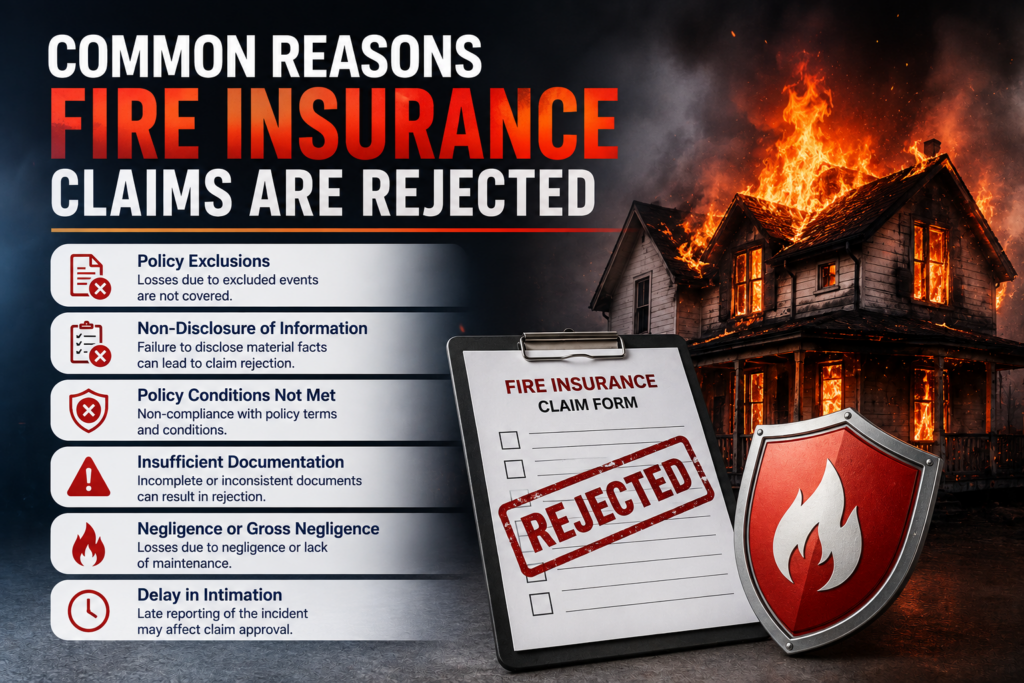
A fire insurance claim rejection occurs when the insurer determines that the reported loss is not payable under the applicable policy. The reason can vary depending on the policy and facts of the case.
Understanding common reasons for fire insurance claim rejection can help policyholders better understand how fire insurance coverage works.
The Cause of Fire Is Excluded
One of the common reasons for rejection is that the cause of the fire falls under an exclusion in the policy.
Insurance policies specify the risks that are covered and those that are excluded. If the circumstances of the fire fall within an excluded category, the insurer may decline the claim.
Policy Was Not Active
Insurance coverage generally applies only when the policy is valid and active at the time of the insured event.
If the policy had expired, been cancelled, or otherwise ceased to provide coverage before the fire occurred, the claim may not be payable.
Property Was Not Insured
A fire insurance policy covers the property and interests specified in the policy.
If the damaged building, stock, machinery, equipment, or other asset was not included within the insured property, the related loss may fall outside the policy coverage.
Important Information Was Not Disclosed
Material information about the insured property or business can be relevant to underwriting and claim assessment.
If important information was not disclosed or was inaccurately represented, it may affect the insurer’s assessment of the claim depending on the circumstances and applicable policy terms.
Policy Exclusions Apply
Fire insurance policies can contain several exclusions.
These may relate to particular causes of loss, types of property, circumstances, or other specified situations.
The existence of fire damage alone does not mean that every resulting loss is covered.
Loss Falls Outside the Policy Coverage
A claim may be rejected when the reported loss does not fall within the risks insured under the policy.
For example, a policy may provide coverage for certain fire-related risks but exclude a particular type of consequential or indirect loss.
Policy Conditions Are Not Satisfied
Insurance policies contain conditions that policyholders are expected to comply with.
A significant breach of an applicable policy condition can affect the insurer’s liability, depending on the nature of the condition and circumstances.
Claim Amount Is Not Supported
A policyholder may claim an amount based on the estimated value of the loss, but the insurer may require information to establish the actual extent and value of the damage.
If the claimed loss cannot be adequately established, it may affect the assessment or settlement of the claim.
This does not necessarily mean that the entire claim will be rejected; the effect depends on the circumstances.
Underinsurance
Underinsurance occurs when the insured value of property is lower than its actual value.
In such circumstances, the amount payable may be affected by the applicable policy provisions and valuation principles.
A fire claim may therefore be settled for less than the amount expected by the policyholder.
Intentional or Fraudulent Loss
Insurance is designed to provide protection against accidental and covered risks.
If evidence indicates that a loss was deliberately caused or that material information was fraudulently presented, the claim can face serious consequences under the policy and applicable law.
Fire Insurance Claim Rejection vs Partial Settlement
A rejected claim and a partially settled claim are different.
A claim rejection means the insurer determines that no amount is payable under the applicable policy.
A partial or short settlement means the insurer accepts liability for part of the claim but pays less than the amount claimed.
Partial settlement can result from policy limits, deductibles, depreciation, underinsurance, exclusions, valuation differences, or other policy conditions.
Insurance Resolve – Fire Insurance Claim Solutions
Insurance Resolve helps policyholders understand insurance concerns including fire insurance claim rejection, claim delays, short-settled claims, insurance mis-selling, policy disputes, service issues, and other insurance problems.
📞 Phone: +91 99103 52249
📧 Email: help@insuranceresolve.com
🌐 Website: www.insuranceresolve.com
Frequently Asked Questions
Why can a fire insurance claim be rejected?
A fire claim can be rejected when the loss is excluded, the policy was not active, the property was not insured, applicable conditions were not satisfied, or other policy provisions prevent payment.
Does every fire automatically qualify for an insurance claim?
No. The cause of the fire and the circumstances of the loss must fall within the coverage provided by the policy.
Can underinsurance affect a fire insurance claim?
Yes. If the insured value is lower than the actual value of the property, applicable underinsurance provisions may affect the amount payable.
Can a fire claim be partially settled instead of rejected?
Yes. An insurer may accept part of a claim while determining that some portion is not payable because of policy limits, exclusions, valuation, deductibles, or other conditions.
Can non-disclosure affect a fire insurance claim?
Yes. Failure to disclose material information can affect claim assessment depending on the nature of the information, policy terms, and circumstances.
Does a fire insurance policy cover every type of fire-related loss?
No. Coverage depends on the insured risks, exclusions, limits, conditions, and other provisions of the policy.
Conclusion
Fire insurance claim rejection can occur for several reasons, including excluded causes of loss, inactive policies, uninsured property, non-disclosure, policy exclusions, underinsurance, unsupported losses, or other applicable policy conditions.
Understanding the difference between covered risks and exclusions is important when evaluating fire insurance protection. The final outcome of a claim depends on the specific policy wording and circumstances of the loss.

