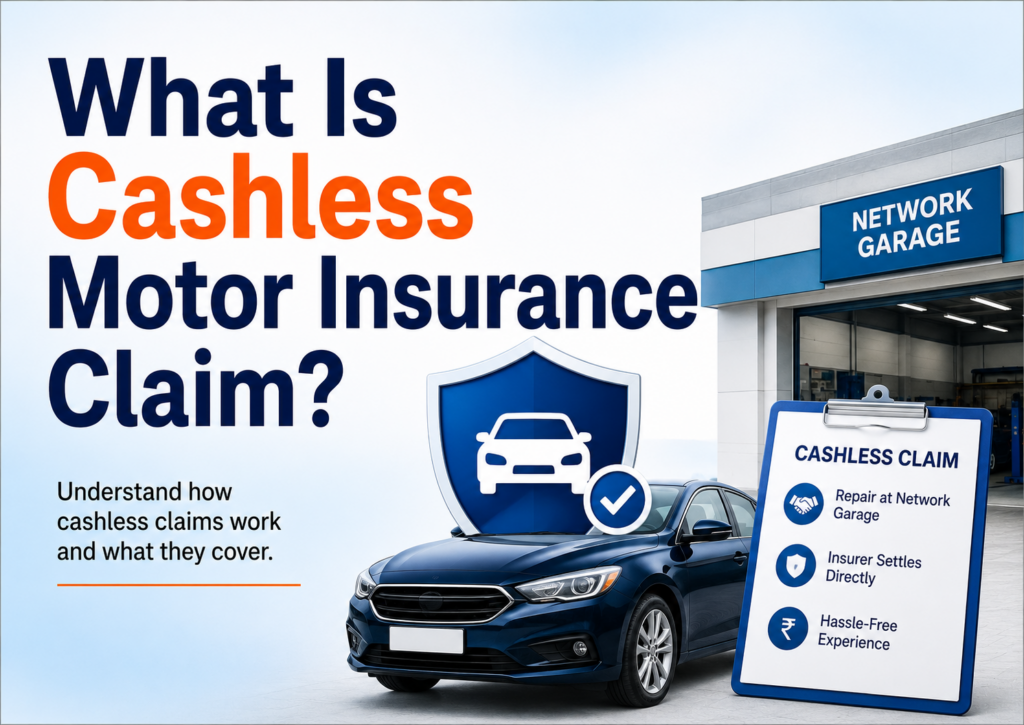

A cashless motor insurance claim is a facility that allows an insured vehicle owner to get their car or two-wheeler repaired at a network garage without paying the entire approved repair bill directly to the garage. Instead, the insurance company settles the eligible claim amount with the network garage, subject to the policy terms and applicable conditions.
This facility can make the motor insurance claim experience more convenient, particularly when a vehicle requires significant repairs after an accident or other covered event.
What Does Cashless Motor Insurance Mean?
Under a cashless claim facility, the insured vehicle is taken to a garage that has a tie-up with the insurance company. After the claim is assessed and approved, the insurer pays the eligible repair expenses directly to the garage.
The policyholder generally remains responsible for amounts that are not covered under the policy, such as deductibles, depreciation where applicable, non-covered parts or services, and expenses exceeding the approved claim amount.
Therefore, cashless does not necessarily mean that the vehicle owner pays nothing.
How Does a Cashless Motor Insurance Claim Work?
The cashless facility is based on coordination between the policyholder, insurer, surveyor or claims team, and network garage. The garage assesses the vehicle and provides an estimate of the expected repair cost. The insurer then evaluates the claim according to the policy coverage and determines the amount that can be approved.
Once the claim is approved, the insurer settles the admissible amount with the network garage. The vehicle owner pays the applicable deductions and expenses that fall outside the insurance coverage.
What Is a Network Garage?
A network garage is a repair workshop that has an arrangement with an insurance company to provide services under its cashless claim facility.
Network garages may differ between insurers. Their availability can also vary depending on the location and the type of vehicle. This is why the list of network garages associated with a particular motor insurance policy can be important when considering repair options.
What Expenses May Be Covered?
The expenses covered through a cashless motor insurance claim depend on the policy and the circumstances of the loss. Depending on the coverage, eligible expenses may include repairs arising from:
- Accidental damage
- Theft-related losses
- Fire
- Flood and other natural events
- Storm or other specified perils
- Damage caused by certain external accidents
The exact coverage depends on the terms, exclusions, deductibles, add-ons, and conditions of the motor insurance policy.
What Does the Policyholder Usually Pay?
Even with a cashless claim, some expenses may remain payable by the vehicle owner. These can include the compulsory deductible, voluntary deductible if selected, depreciation under applicable policies, excluded items, and repair costs that are not approved by the insurer.
For example, if the total repair bill is ₹80,000 but only ₹65,000 is admissible under the policy, the remaining amount may have to be paid by the policyholder.
Cashless Claim vs Reimbursement Claim
The main difference is how the approved repair expenses are settled.
With a cashless claim, the insurer generally settles the approved amount directly with a network garage.
With a reimbursement claim, the policyholder may initially pay the repair expenses and subsequently seek reimbursement from the insurer, subject to policy coverage and claim assessment.
Both facilities are subject to the terms and conditions of the applicable motor insurance policy.
Is Cashless Motor Insurance Available for Every Claim?
Not necessarily. Cashless settlement depends on factors such as the insurer’s network garage arrangements, policy coverage, claim admissibility, and the circumstances of the loss.
A claim may also involve certain expenses that are outside the scope of the policy even when the repair is carried out at a network garage.
Importance of Understanding Cashless Claim Coverage
Understanding the difference between cashless settlement and complete coverage is important for vehicle owners. A cashless facility primarily concerns the method of settling eligible repair expenses; it does not automatically expand the coverage provided by the insurance policy.
The policyholder should therefore be aware of the insured vehicle’s coverage, deductibles, exclusions, depreciation rules, add-ons, and other applicable conditions.
Conclusion
A cashless motor insurance claim provides a convenient way of settling eligible vehicle repair expenses through a network garage. Instead of the policyholder paying the entire approved repair cost upfront, the insurer generally settles the admissible amount directly with the garage.
However, cashless does not mean that every repair expense is covered. The actual claim settlement depends on the insurance policy, claim assessment, deductibles, exclusions, and other applicable conditions.
For general information about insurance claims and policy-related concerns:
Phone: +91 99103-52249
Email: help@insuranceresolve.com
Website: www.insuranceresolve.com