
Property insurance is designed to protect homes, offices, shops, factories, and other buildings against financial losses caused by unexpected events. While many policyholders focus on the risks that are covered, it is equally important to understand what is excluded from coverage. Insurance policies contain exclusions that define situations, events, or types of damage for which the insurer will not pay a claim.
Understanding these exclusions helps policyholders set realistic expectations and avoid unpleasant surprises when a loss occurs. Although exclusions can vary between insurers and policy types, several are commonly found in most property insurance policies.
The Purpose of Exclusions
Insurance is intended to cover sudden and unforeseen losses rather than predictable, gradual, or preventable damage. Exclusions help insurers define the scope of coverage and ensure that risks outside the intended protection are not included. They also encourage property owners to maintain their buildings properly and manage risks responsibly.
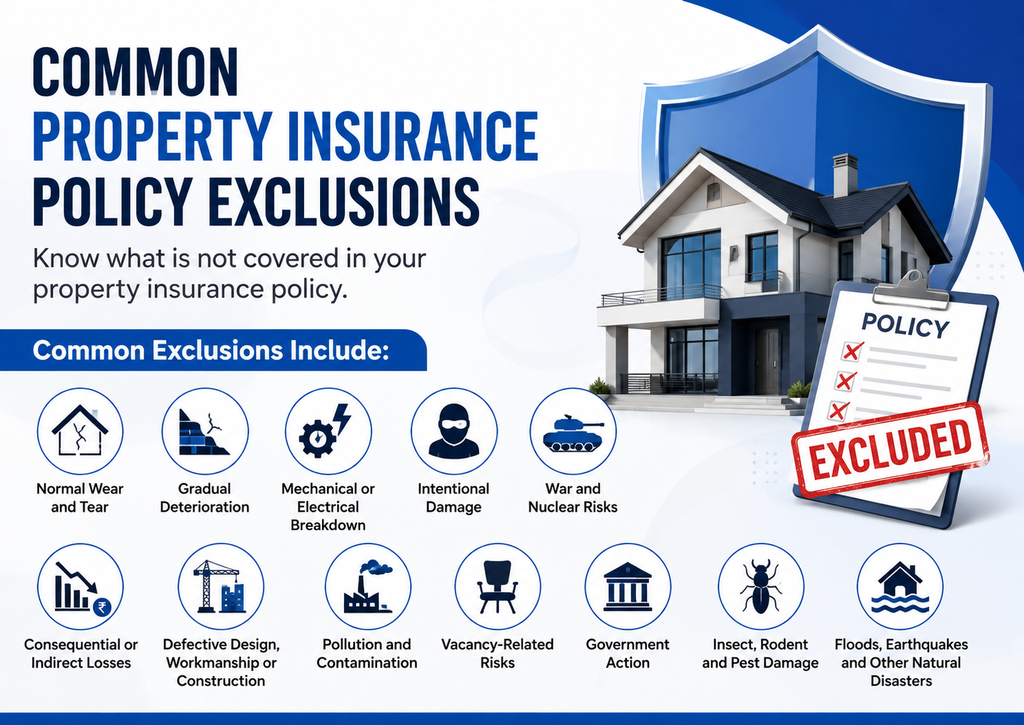
Normal Wear and Tear
One of the most common exclusions in property insurance is damage caused by normal wear and tear. Buildings naturally deteriorate over time due to aging, weather exposure, and regular use. Cracked paint, faded surfaces, corroded pipes, and aging roofs are generally considered maintenance issues rather than insured events.
Insurance is not a substitute for routine property upkeep, and policyholders are expected to maintain their properties in good condition.
Gradual Deterioration
Damage that develops slowly over time is often excluded. Examples include rust, corrosion, mold growth resulting from long-term moisture issues, and structural weakening due to neglect. Since these problems usually occur gradually and can often be prevented through maintenance, they are not typically covered under standard property insurance policies.
Mechanical or Electrical Breakdown
Property insurance generally covers damage caused by insured events such as fire or lightning, but not the failure of machinery, equipment, or electrical systems due to internal defects or breakdowns.
For example, if an air-conditioning system stops working because of a mechanical failure, the repair cost may not be covered. However, if the breakdown causes a fire that damages the building, the resulting fire damage may be covered depending on policy terms.
Intentional Damage
Insurance policies do not cover losses caused deliberately by the policyholder or anyone acting on their behalf. Property insurance is intended to protect against accidental events, not intentional acts.
This exclusion helps prevent fraudulent claims and ensures that insurance remains a mechanism for managing genuine risks.
War and Nuclear Risks
Most property insurance policies exclude losses arising from war, invasion, military action, civil war, rebellion, or nuclear incidents. These events can lead to widespread and catastrophic losses that are difficult for insurers to predict and manage.
As a result, they are commonly excluded from standard property insurance coverage worldwide.
Consequential or Indirect Losses
Property insurance primarily covers direct physical damage to insured property. Financial losses that occur as a consequence of the damage may not be covered unless specifically included in the policy.
For example, loss of business income, loss of market value, delayed projects, or reduced productivity following property damage may require separate insurance coverage rather than being covered automatically under a standard property policy.
Defective Design, Workmanship, or Construction
Damage resulting from faulty design, poor workmanship, construction defects, or the use of defective materials is often excluded. If a building develops structural problems because of construction errors, insurers may consider the issue to be a quality or contractual matter rather than an insurable event.
However, resulting damage caused by a separate insured peril may sometimes be treated differently depending on policy wording.
Pollution and Contamination
Many property insurance policies exclude losses arising from pollution, contamination, or environmental damage unless specifically endorsed. Chemical spills, industrial contamination, or hazardous material releases can create significant financial liabilities that fall outside standard property coverage.
Specialized insurance solutions are often required for environmental risks.
Vacancy-Related Risks
Properties left vacant for extended periods may face higher risks of theft, vandalism, water damage, and other losses. Some policies restrict coverage or apply special conditions when a property remains unoccupied beyond a specified period.
Insurers often view vacant buildings as higher-risk properties because problems may go unnoticed for longer periods.
Government Action
Losses resulting from confiscation, seizure, destruction, or acquisition of property by government authorities are commonly excluded. These situations arise from legal or regulatory actions rather than accidental events and therefore fall outside the intended scope of property insurance.
Insect, Rodent, and Pest Damage
Damage caused by termites, rodents, insects, birds, or other pests is usually excluded because it is considered a maintenance issue. Pest-related damage often develops gradually and can typically be prevented through proper inspections and preventive measures.
Floods, Earthquakes, and Other Catastrophic Events
In some policies, natural catastrophes such as floods, earthquakes, landslides, or storm surges may not be covered automatically. Depending on the insurer and policy type, these risks may require separate coverage or specific endorsements.
Policyholders should carefully review their policy schedule to understand whether catastrophic events are included or excluded.
Why Reading Policy Exclusions Matters
Many claim disputes arise not because coverage is absent, but because policyholders were unaware of specific exclusions. Understanding exclusions provides a clearer picture of what protection the policy offers and where additional coverage may be necessary.
A well-informed policyholder is better equipped to assess risks, maintain property properly, and make decisions about insurance coverage that align with their needs.
Conclusion
Property insurance provides valuable financial protection against many unexpected events, but it is not an all-risk solution. Exclusions are an essential part of every policy and define the boundaries of coverage. By understanding common exclusions such as wear and tear, gradual deterioration, mechanical breakdowns, construction defects, pollution, war risks, and vacancy-related losses, property owners can gain a more complete understanding of their insurance protection.
Taking time to review policy terms and exclusions helps ensure that expectations match reality and reduces the likelihood of surprises during the claims process.
Phone: +91 99103-52249
Email: help@insuranceresolve.com
Website: www.insuranceresolve.com

