

When an insurance claim does not get settled as expected, policyholders often confuse claim rejection with claim delay. Although both can create problems, they are different situations with different implications.
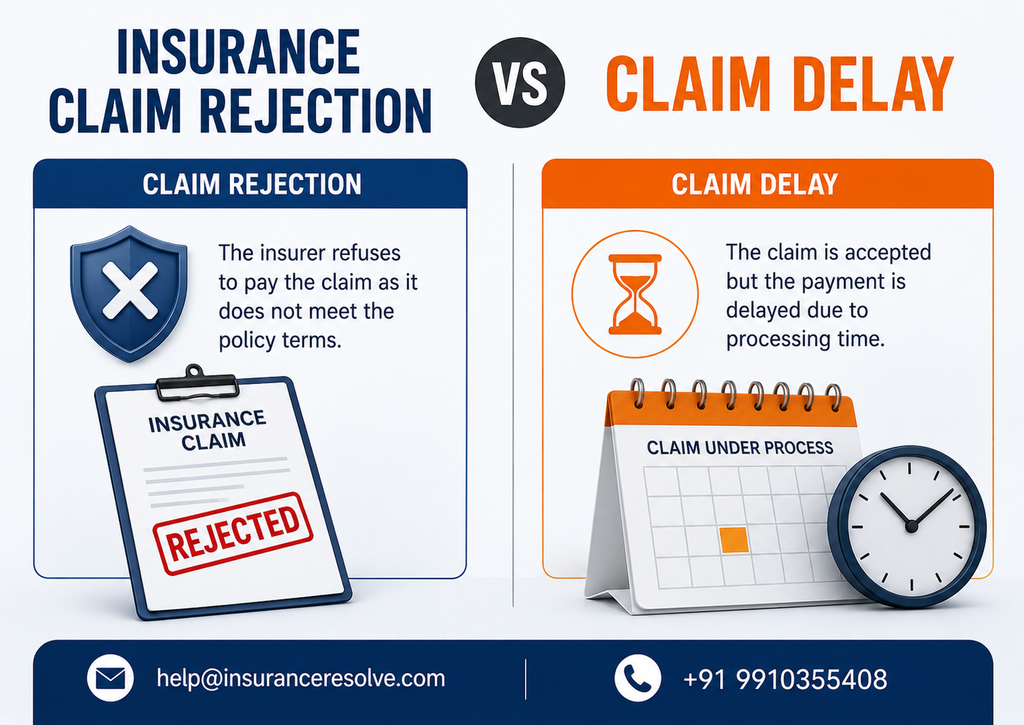
Understanding the difference between an insurance claim rejection and claim delay can help policyholders better understand the status of their claim.
What Is an Insurance Claim Delay?
An insurance claim delay occurs when a claim takes longer than expected to process or settle.
A delayed claim may still be under investigation, documentation review, survey, assessment, or approval.
Common reasons for claim delays can include:
- Incomplete documentation
- Survey or loss assessment
- Verification of the incident
- Policy coverage review
- Valuation of the loss
- Third-party information
- Communication or service issues
A delayed claim does not necessarily mean that the insurer has decided against paying it.
What Is an Insurance Claim Rejection?
An insurance claim rejection occurs when the insurer makes a decision not to pay the claim based on stated reasons.
A claim may be rejected when the insurer determines that the loss is not covered, falls under an exclusion, or does not meet applicable policy conditions.
Common reasons can include:
- Policy exclusions
- Loss outside the policy coverage
- Breach of policy conditions
- Insufficient evidence
- Misrepresentation or non-disclosure
- Uncovered circumstances
- Other reasons specified under the policy
Key Difference Between Claim Rejection and Claim Delay
The main difference is the status of the claim.
| Claim Delay | Claim Rejection |
|---|---|
| Claim is still being processed or assessed | Insurer has made a decision not to pay |
| No final adverse decision may have been made | A rejection decision has been made |
| May involve investigation or documentation | Usually involves stated grounds for rejection |
| Claim may still be settled | Claim has been declined based on the insurer’s assessment |
Why Do Insurance Claims Get Delayed?
Insurance claims can involve several stages of verification and assessment. For complex claims, the insurer may require additional information before reaching a decision.
For example, motor, fire, property, marine, and business insurance claims may require surveys, inspections, valuation, or detailed documentation.
Why Are Insurance Claims Rejected?
Claim rejection can occur when the insurer determines that the reported loss does not fall within the policy coverage.
Policy exclusions, conditions, documentation, circumstances of the loss, and other policy provisions can influence the decision.
Can a Delayed Claim Eventually Be Rejected?
Yes. A claim that is initially under assessment can eventually result in a rejection if the insurer determines, after reviewing the circumstances and policy terms, that the claim is not payable.
Therefore, a delay should not automatically be interpreted as either approval or rejection.
Can a Rejected Claim Be Challenged?
If a policyholder believes that a claim has been incorrectly rejected, it is important to understand the stated reason for rejection and compare it with the applicable policy terms and available evidence.
A professional review may help clarify whether there is a genuine coverage or assessment dispute.
Common Insurance Claim Problems
Policyholders may experience several types of insurance-related problems, including:
- Claim rejection
- Claim delay
- Short settlement
- Policy rejection
- Mis-selling
- Service issues
- Coverage disputes
Understanding the specific nature of the problem is important because each situation can involve different policy considerations.
Get Help With Insurance Claim Problems
If your insurance claim has been rejected, delayed, or short-settled, Insurance Resolve provides professional guidance for policyholders dealing with insurance claim and complaint-related concerns.
Insurance Resolve – Insurance Claim & Complaint Solutions
📞 Phone: +91 99103-52249
📧 Email: help@insuranceresolve.com
🌐 Website: www.insuranceresolve.com
Frequently Asked Questions
What is the difference between claim rejection and claim delay?
A claim delay means the claim is taking longer to process, while claim rejection means the insurer has decided not to pay the claim based on stated reasons.
Does a delayed insurance claim mean it will be rejected?
No. A delayed claim may still be under assessment and can ultimately be approved, partially settled, or rejected depending on the circumstances and policy terms.
Why do insurers delay claims?
Claims may be delayed because of documentation, investigation, survey, valuation, coverage assessment, or third-party verification.
Why do insurers reject claims?
Claims may be rejected when the insurer determines that the loss is excluded, outside the policy coverage, unsupported by sufficient evidence, or affected by applicable policy conditions.
Can Insurance Resolve help with claim rejection or delay?
Yes. Insurance Resolve provides professional guidance for policyholders facing insurance claim rejection, claim delay, short settlement, and other insurance-related problems.

