

Insurance claims are an important part of general insurance because they provide financial protection when an insured event causes a covered loss. However, not every claim is approved by an insurance company. A general insurance claim may be rejected when the circumstances of the loss do not meet the coverage, conditions, or requirements specified in the insurance policy.
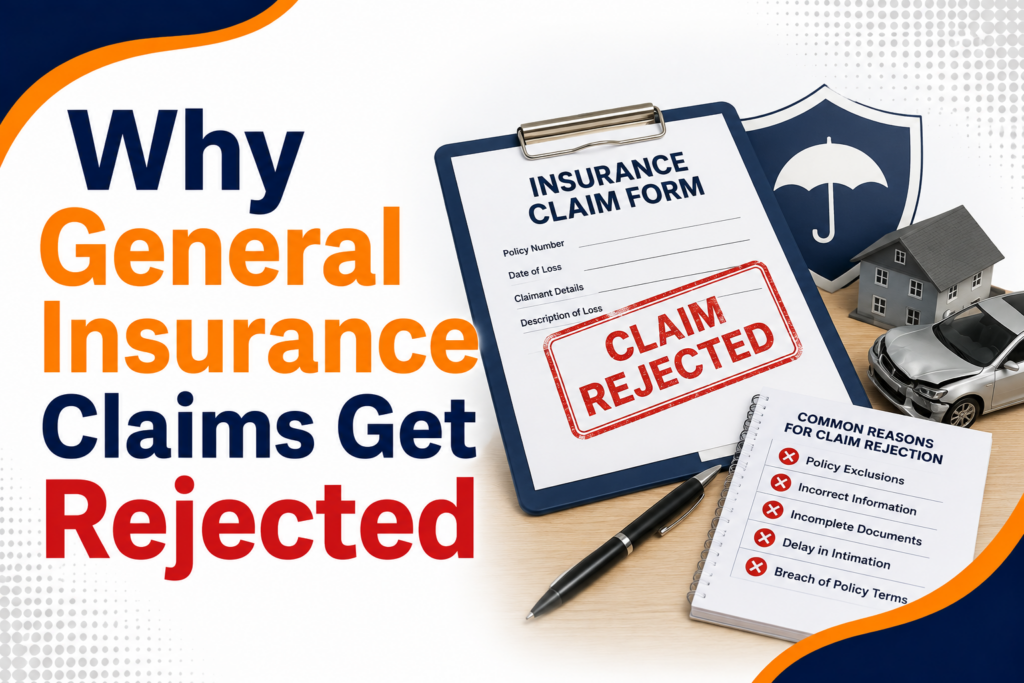
Claim rejection can occur across different types of general insurance, including motor, property, fire, marine, commercial, travel, and other non-life insurance products.
Understanding the common reasons behind claim rejection provides policyholders with greater awareness of how insurance coverage works.
What Is a General Insurance Claim Rejection?
A general insurance claim rejection occurs when an insurer declines liability for a claim and determines that no payment is payable under the applicable policy.
A rejection is different from a partially settled claim, where the insurer accepts the claim but pays less than the amount claimed.
It is also different from a claim delay, where the final decision has not yet been made within the expected timeframe.
Why Do General Insurance Claims Get Rejected?
There can be several reasons why a general insurance claim is rejected. The exact reason depends on the type of insurance, policy wording, circumstances of the loss, and information available to the insurer.
1. The Event Is Not Covered
Insurance policies provide protection only against specified risks.
If the cause of the loss is outside the policy coverage, the insurer may reject the claim.
For example, a policy may cover accidental damage but exclude a particular type of loss or event.
2. Policy Exclusions Apply
Every insurance policy contains exclusions.
Exclusions identify situations, losses, property, expenses, or circumstances for which the insurer does not provide coverage.
If an exclusion applies to the claim, the insurer may decline liability.
3. The Policy Was Not Active
Insurance coverage generally applies during the policy period.
If the insured event occurs when the policy has expired, been cancelled, or otherwise ceased to provide coverage, the claim may be rejected.
4. Incorrect or Incomplete Information
Insurance contracts rely on information provided by the policyholder.
Incorrect, incomplete, or inconsistent information relating to the insured property, vehicle, business activity, risk, or circumstances of the loss can affect claim eligibility.
5. Non-Disclosure of Material Information
Material information can be important to the insurer’s assessment of risk.
If relevant information was not disclosed when required, it may affect the insurer’s decision regarding a claim, depending on the policy and applicable regulations.
6. Violation of Policy Conditions
Insurance policies contain specific conditions that policyholders are expected to comply with.
A breach of an applicable policy condition can affect the insurer’s liability and may result in claim rejection in certain circumstances.
7. Lack of Applicable Coverage
A policyholder may have insurance but not necessarily coverage for every possible type of loss.
For example, having a basic motor insurance policy does not automatically mean that every type of damage to the insured vehicle is covered.
The actual coverage depends on the policy selected.
8. Loss Falls Outside the Insured Property
Insurance generally covers the property or interest specified in the policy.
If the damaged or lost property is not included within the insured coverage, the related claim may not be payable.
9. Insufficient Supporting Evidence
Insurance claims may require documents or evidence that establish the occurrence and extent of the insured loss.
If the available information does not adequately establish the claim, the insurer may question or decline liability depending on the circumstances and policy requirements.
10. Fraud or Misrepresentation
Fraudulent claims or deliberate misrepresentation can have serious consequences.
If an insurer determines that a claim involves fraudulent information, fabricated evidence, deliberate concealment, or other dishonest conduct, the claim may be rejected according to the applicable policy and law.
11. Loss Caused by an Excluded Activity
Some policies cover specific activities, uses, or circumstances.
If the insured property is used in a manner that falls outside the permitted or insured use, the resulting claim may be affected.
This can be relevant to motor, commercial, property, and other forms of general insurance.
12. Policy Limits or Conditions
A claim may be affected by the limits and conditions specified in the insurance policy.
While policy limits more commonly result in partial settlement rather than complete rejection, certain circumstances may make a particular part of the claim ineligible for payment.
General Insurance Claims Can Be Rejected Across Different Policies
Claim rejection is not limited to one type of insurance.
Motor Insurance Claims
Motor insurance claims may be rejected because of exclusions, policy conditions, invalid coverage, use of the vehicle outside the permitted purpose, or other circumstances affecting coverage.
Property Insurance Claims
Property insurance claims may be rejected when the cause of damage is excluded, the property is not insured, or the circumstances fall outside the policy coverage.
Fire Insurance Claims
Fire insurance claims may be affected by exclusions, policy conditions, non-covered property, or circumstances surrounding the fire.
Marine Insurance Claims
Marine insurance claims may be rejected when the loss occurs outside the insured journey, involves an excluded risk, or does not satisfy applicable policy conditions.
Commercial Insurance Claims
Commercial insurance claims can involve complex coverage conditions. A claim may be rejected when the business activity, property, liability, or loss does not fall within the insured coverage.
Claim Rejection vs Partial Settlement
It is important to understand the difference between these two outcomes.
Claim Rejection: The insurer declines the claim and determines that no amount is payable.
Partial Settlement: The insurer accepts liability for part of the claim but pays less than the amount claimed.
For example, if a policyholder claims ₹10 lakh and the insurer determines that ₹6 lakh is payable, this would generally be a partial settlement rather than a complete rejection.
Does Claim Rejection Always Mean the Claim Is Invalid?
Not necessarily.
A claim rejection represents the insurer’s decision based on its assessment of the policy and circumstances. The reason for rejection is important because the decision may depend on how the policy terms apply to the particular event.
Policyholders may have concerns when the rejection reason is unclear, appears inconsistent with the policy wording, or does not adequately explain the basis of the decision.
Importance of the Policy Wording
The insurance policy is the primary document defining the contractual relationship between the insurer and policyholder.
It contains information about:
- Coverage
- Exclusions
- Policy limits
- Deductibles
- Conditions
- Insured property
- Claim-related provisions
- Other applicable restrictions
Understanding these provisions provides important context when evaluating an insurance claim decision.
Insurance Resolve – General Insurance Claim & Complaint Solutions
Insurance Resolve helps policyholders understand general insurance concerns, including claim rejection, claim delays, short-settled claims, insurance mis-selling, lapsed policies, service issues, motor insurance claims, property insurance concerns, commercial insurance matters, and other insurance problems.
The objective is to provide greater clarity regarding insurance policies, claim decisions, and insurance-related concerns.
📞 Phone: +91 99103 52249
📧 Email: help@insuranceresolve.com
🌐 Website: www.insuranceresolve.com
Frequently Asked Questions (FAQs)
1. Why do general insurance claims get rejected?
General insurance claims may be rejected because the loss is not covered, an exclusion applies, the policy was inactive, a policy condition was not satisfied, or other circumstances affect the insurer’s liability.
2. What is a rejected insurance claim?
A rejected insurance claim is a claim where the insurer declines liability and determines that no payment is payable under the applicable policy.
3. Is claim rejection the same as partial settlement?
No. Rejection means the insurer declines the claim, while partial settlement means the insurer accepts part of the claim and pays a lower amount than claimed.
4. Can an expired policy result in claim rejection?
Yes. If the insured event occurs after the policy has expired and no coverage applies, the claim may not be payable.
5. Can policy exclusions cause claim rejection?
Yes. If the circumstances of the loss fall within an applicable exclusion, the insurer may reject the claim.
6. Can incorrect information affect an insurance claim?
Yes. Incorrect, incomplete, or inconsistent information can affect claim assessment and may result in rejection depending on the circumstances and policy terms.
7. Can fraud result in claim rejection?
Yes. Fraudulent claims, deliberate misrepresentation, or fabricated evidence can result in claim rejection and may have other legal or contractual consequences.
8. Can a motor insurance claim be rejected?
Yes. Motor insurance claims can be rejected for reasons including exclusions, policy conditions, invalid coverage, or circumstances that fall outside the insured use or policy terms.
9. Can a property insurance claim be rejected?
Yes. A property claim may be rejected when the cause of damage is excluded, the property is not covered, or other applicable policy conditions affect coverage.
10. Can a commercial insurance claim be rejected?
Yes. Commercial claims can be rejected when the reported loss, activity, property, or liability falls outside the policy coverage or an applicable exclusion or condition applies.
11. Can Insurance Resolve help with a rejected general insurance claim?
Insurance Resolve assists policyholders in understanding concerns related to general insurance claim rejection, claim delays, partial settlements, mis-selling, lapsed policies, and service-related issues.
Conclusion
General insurance claims can be rejected for several reasons, including lack of coverage, policy exclusions, inactive policies, incorrect information, non-disclosure, policy condition violations, insufficient evidence, fraud, and losses outside the insured scope.
A claim rejection is different from a partial settlement or claim delay. The reason provided for the decision and the applicable policy terms are important factors in understanding why a particular claim has not been approved.
General insurance policies can differ significantly, so the actual reason for claim rejection depends on the specific policy and circumstances of the insured event.

