
Liability insurance can protect businesses and individuals against certain legal and financial responsibilities arising from covered incidents. However, liability insurance does not provide unlimited protection.
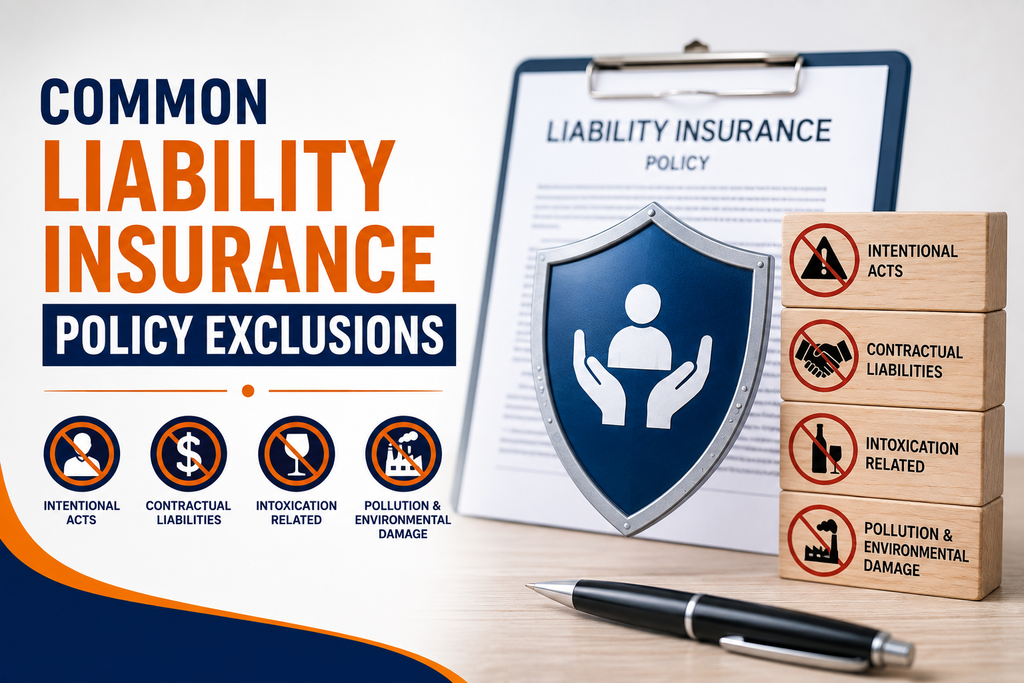
Every liability insurance policy contains exclusions that identify situations, losses, activities, or circumstances that are not covered. These exclusions can vary depending on the type of liability insurance and the policy wording.
Understanding common exclusions helps explain the limits of liability insurance coverage.
What Are Liability Insurance Exclusions?
Liability insurance exclusions are specific situations or types of losses for which the insurer does not provide coverage.
An exclusion may apply because the risk is considered outside the purpose of the policy, requires separate insurance, or is specifically removed from coverage by the policy terms.
The exact meaning of an exclusion depends on the wording of the individual policy.
Intentional or Deliberate Acts
Liability policies generally do not provide protection for losses caused intentionally by the insured.
Insurance is primarily designed to protect against unforeseen risks. Deliberately causing damage or injury may therefore fall outside the scope of coverage.
The precise application can depend on the policy wording and applicable law.
Contractual Liability
Some liability policies exclude certain liabilities that arise solely because the insured entered into a contract.
For example, a business may agree to accept a responsibility under a contract that it would not otherwise have under ordinary law. Such contractual obligations may not automatically be covered under a standard liability policy.
Some policies may provide limited contractual liability coverage or specific extensions.
Professional Errors and Negligence
General liability insurance may not cover claims arising from professional advice, professional services, or errors and omissions.
Professionals such as consultants, architects, accountants, engineers, and other service providers may require separate professional indemnity or errors and omissions insurance for these risks.
Employee-Related Claims
Certain claims involving employees may be excluded from general liability policies because they are intended to be addressed through workers’ compensation, employer’s liability, or other employment-related insurance.
The exact treatment depends on the jurisdiction and the insurance policy.
Motor Vehicle Liability
Liability arising from the ownership or use of vehicles is commonly handled through motor insurance rather than a standard general liability policy.
A business that operates vehicles may therefore require separate motor liability coverage.
Pollution and Environmental Damage
Pollution-related claims are often subject to specific exclusions or limitations under general liability policies.
Environmental contamination can involve significant and specialized risks, so separate environmental liability coverage may be required for certain businesses.
Product-Related Risks
Product liability may be covered under some commercial liability policies, but the scope of coverage can vary.
Certain products, activities, or circumstances may be excluded or subject to specific conditions and limits.
Businesses involved in manufacturing, importing, distributing, or selling products need to understand how their policy treats product-related claims.
Damage to the Insured’s Own Property
Liability insurance is generally intended to cover the insured’s legal liability to third parties rather than damage to the insured’s own property.
Damage to the business’s own building, machinery, stock, or equipment is usually addressed through property insurance or other relevant coverage.
Fines, Penalties, and Punitive Damages
Insurance policies may exclude certain government fines, penalties, or punitive damages.
Whether such amounts can be insured can also depend on applicable law and the specific policy wording.
War and Terrorism
War, terrorism, civil unrest, or similar events may be excluded or subject to special conditions depending on the policy and type of insurance.
Separate coverage or extensions may sometimes be available for specific risks.
Asbestos and Other Hazardous Materials
Certain liability policies may contain exclusions relating to asbestos, hazardous substances, toxic materials, or other specialized risks.
Businesses involved in industries where these exposures are significant may require specialized insurance protection.
Known or Existing Circumstances
Insurance is generally intended to cover uncertain future events rather than losses that were already known or had already occurred before coverage began.
Policies may therefore contain provisions relating to known circumstances, prior incidents, or claims that existed before the policy period.
Why Exclusions Matter
The presence of an exclusion does not necessarily mean that liability insurance is inadequate. Exclusions help define what the policy is designed to cover and what falls outside its intended scope.
Different types of liability insurance exist because businesses and individuals face different categories of risks.
Final Thoughts
Liability insurance can provide valuable financial protection, but it does not cover every possible liability. Common exclusions can involve intentional acts, certain contractual responsibilities, professional services, employee-related claims, motor vehicles, pollution, property owned by the insured, fines and penalties, and other specified risks.
The exclusions can differ significantly between policies. Therefore, the policy wording, definitions, conditions, limits, and exclusions are important when determining the actual scope of liability insurance coverage.

