

Third-party motor insurance is a type of motor insurance that provides financial protection against certain legal liabilities arising from injury, death, or property damage caused to a third party by an insured vehicle.
In India, third-party motor insurance is an important part of motor vehicle insurance and is legally required for vehicles operating on public roads, subject to applicable laws and regulations.
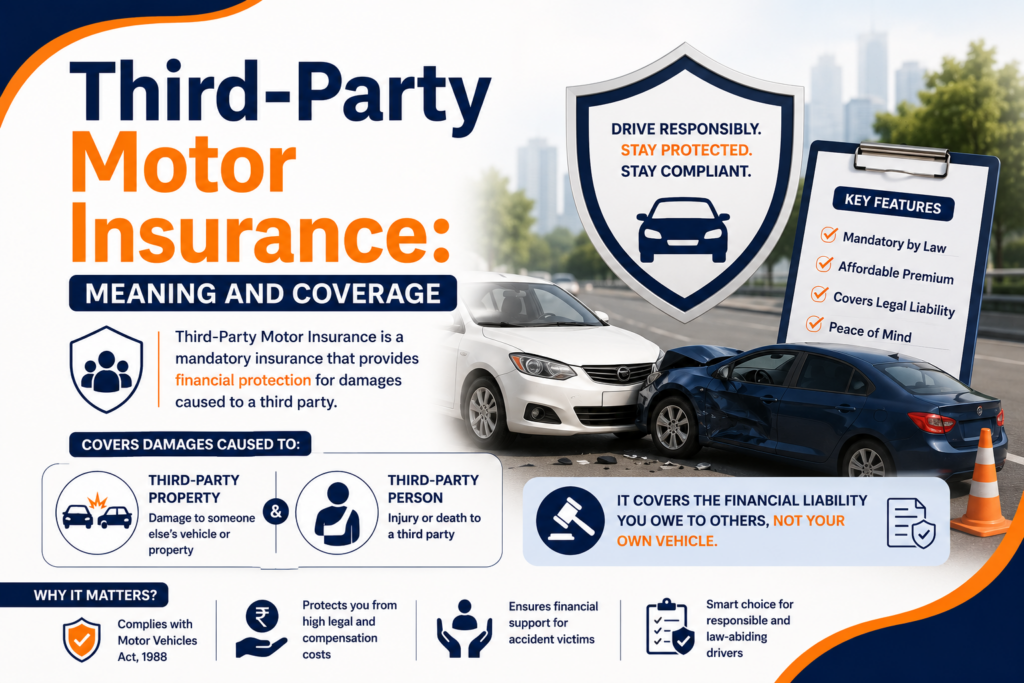
Unlike comprehensive motor insurance, third-party insurance primarily focuses on liabilities toward other people and their property rather than providing broad protection for damage to the insured vehicle itself.
What Is Third-Party Motor Insurance?
Third-party motor insurance is an insurance policy that provides coverage for specified liabilities arising when the insured vehicle causes harm to another person or damages third-party property.
There are generally three parties involved:
- First party: The policyholder or insured vehicle owner.
- Second party: The insurance company.
- Third party: Another person who suffers injury, death, or property damage due to the insured vehicle.
The insurer’s responsibility depends on the applicable law and the terms of the insurance arrangement.
Why Is Third-Party Motor Insurance Important?
Vehicles can create financial and legal risks for other people on the road.
An accident involving an insured vehicle may result in bodily injury, death, or damage to another person’s property. Third-party insurance provides a mechanism for dealing with specified financial liabilities arising from such incidents.
For this reason, third-party motor insurance is an important component of India’s motor insurance system.
What Does Third-Party Motor Insurance Cover?
Third-party motor insurance generally provides protection for certain liabilities involving:
Third-Party Injury
If an insured vehicle causes injury to another person, the applicable third-party insurance may provide protection against the insured’s legal liability, subject to applicable law and policy provisions.
Third-Party Death
Where an accident involving the insured vehicle results in the death of a third party, third-party motor insurance can provide protection against applicable legal liability.
The amount and nature of compensation are determined according to the applicable legal framework and circumstances of the case.
Third-Party Property Damage
Third-party motor insurance can also provide coverage for certain damage caused to third-party property by the insured vehicle.
This may include damage to another vehicle or other eligible third-party property, subject to applicable limits and conditions.
What Is Not Covered by Third-Party Motor Insurance?
Third-party insurance primarily protects against specified liabilities toward third parties. It does not generally provide comprehensive protection for the policyholder’s own vehicle.
Common areas that are generally outside basic third-party coverage include:
- Damage to the insured vehicle.
- Theft of the insured vehicle.
- Fire damage to the insured vehicle.
- Natural calamity damage to the insured vehicle.
- Other own-damage losses not covered by the policy.
- Own-vehicle accident repair costs.
Separate own-damage or comprehensive coverage may provide protection for such risks, depending on the policy.
Third-Party Insurance and Own-Damage Insurance
The distinction between third-party and own-damage coverage is important.
Third-party insurance primarily covers specified liabilities toward other people and their property.
Own-damage insurance provides protection for the insured vehicle against specified risks.
Comprehensive motor insurance generally combines third-party liability coverage with own-damage protection for specified risks.
Is Third-Party Motor Insurance Mandatory in India?
Third-party motor insurance is legally required for vehicles used on public roads in India, subject to applicable laws and regulations.
The requirement exists because road accidents can create financial and legal liabilities toward other people.
The exact legal requirements can depend on the type and use of the vehicle and applicable regulations.
Third-Party Motor Insurance for Cars
Car owners are required to maintain applicable third-party motor insurance when using their vehicles on public roads.
The policy provides protection against specified third-party liabilities arising from the use of the insured car.
However, basic third-party insurance does not generally cover damage to the insured car itself.
Third-Party Motor Insurance for Two-Wheelers
Two-wheelers are also subject to applicable third-party motor insurance requirements.
The coverage relates to specified liabilities arising from accidents involving the insured two-wheeler.
Damage to the insured two-wheeler itself is generally not covered under basic third-party-only insurance.
Third-Party Property Damage
Third-party property damage refers to damage caused to property belonging to another person.
For example, an accident may result in damage to another vehicle, building, boundary structure, or other eligible property.
The applicable insurance protection depends on the policy, legal provisions, and circumstances of the incident.
Third-Party Bodily Injury and Death
Third-party bodily injury and death claims can involve significant legal and financial consequences.
The compensation associated with such claims may depend on factors such as the nature of the injury, circumstances of the accident, applicable law, and decisions of the relevant authorities or courts.
Third-party motor insurance provides financial protection against covered legal liabilities according to the applicable framework.
Third-Party Motor Insurance Premium
The premium for third-party motor insurance is influenced by applicable regulatory requirements and vehicle-related factors.
For certain categories of vehicles, third-party premium rates may be determined or regulated under the applicable framework.
The premium structure can differ depending on the type and characteristics of the vehicle.
Third-Party Motor Insurance Claims
A third-party motor insurance claim can arise when an accident involving the insured vehicle results in a covered third-party injury, death, or property damage.
The assessment of a third-party claim can involve the circumstances of the accident, available evidence, legal liability, applicable insurance coverage, and other relevant factors.
Third-party claims involving bodily injury or death can also involve legal proceedings and compensation assessment under the applicable law.
Can Third-Party Claims Be Rejected?
Third-party motor insurance claims are subject to applicable legal and policy provisions.
Certain circumstances may affect the insurer’s liability or the handling of a claim. These can include issues relating to policy validity, vehicle use, policy conditions, documentation, or other applicable legal factors.
The specific outcome depends on the circumstances of the incident and the applicable law and insurance terms.
Third-Party Insurance and Vehicle Damage
One of the most important characteristics of third-party-only insurance is that it does not generally provide own-damage protection.
For example, if an insured car is involved in an accident and the car itself is damaged, basic third-party insurance generally does not pay for the repair of that car.
Own-damage or comprehensive coverage may be relevant for protection against specified damage to the insured vehicle.
Third-Party Insurance vs Comprehensive Motor Insurance
| Feature | Third-Party Insurance | Comprehensive Motor Insurance |
|---|---|---|
| Third-party liability | Yes | Yes |
| Third-party property damage | Subject to applicable coverage | Subject to applicable coverage |
| Own vehicle accident damage | Generally not covered | Generally covered for specified risks |
| Vehicle theft | Generally not covered | Generally covered |
| Fire damage to own vehicle | Generally not covered | Generally covered |
| Natural calamity damage to own vehicle | Generally not covered | Generally covered |
| Coverage scope | More limited | Broader |
The exact coverage depends on the individual policy.
Importance of Understanding Third-Party Coverage
Third-party motor insurance provides important financial protection, but its coverage is different from comprehensive insurance.
A vehicle owner with only third-party insurance should understand that protection for the owner’s own vehicle is generally not included.
The policy terms, applicable legal requirements, limits, and conditions determine the actual scope of protection.
Insurance Resolve – Motor Insurance Claim & Complaint Solutions
Insurance Resolve helps policyholders understand motor insurance-related concerns, including third-party insurance claims, claim rejection, claim delays, short-settled claims, comprehensive motor insurance, insurance mis-selling, policy servicing issues, and other insurance problems.
The objective is to provide greater clarity regarding insurance policies, claim decisions, and insurance-related concerns.
📞 Phone: +91 99103 52249
📧 Email: help@insuranceresolve.com
🌐 Website: www.insuranceresolve.com
Frequently Asked Questions (FAQs)
1. What is third-party motor insurance?
Third-party motor insurance provides financial protection against specified legal liabilities arising from injury, death, or property damage caused to a third party by the insured vehicle.
2. Is third-party motor insurance mandatory in India?
Yes. Third-party motor insurance is legally required for vehicles used on public roads in India, subject to applicable laws and regulations.
3. Does third-party insurance cover damage to my own vehicle?
Generally, no. Basic third-party insurance primarily covers specified liabilities toward third parties and does not generally cover damage to the insured vehicle.
4. Does third-party insurance cover another person’s vehicle?
It can provide coverage for eligible third-party property damage caused by the insured vehicle, subject to applicable limits, terms, and legal provisions.
5. Does third-party insurance cover injury to another person?
Yes. Third-party motor insurance provides protection against specified legal liability arising from third-party bodily injury, subject to applicable law and insurance provisions.
6. Does third-party insurance cover death caused by a road accident?
Third-party insurance can provide protection against applicable legal liability arising from the death of a third party caused by an insured vehicle, subject to the applicable legal framework.
7. Does third-party insurance cover theft of my vehicle?
No. Basic third-party motor insurance generally does not provide coverage for theft of the insured vehicle.
8. What is the difference between third-party and comprehensive motor insurance?
Third-party insurance primarily covers specified liabilities toward third parties, while comprehensive motor insurance generally combines third-party liability protection with own-damage coverage for specified risks.
9. Can third-party insurance claims be rejected?
The handling of a third-party claim depends on applicable law, policy provisions, the circumstances of the accident, and other relevant factors.
10. Can third-party insurance cover damage to property?
Yes. Third-party motor insurance can provide coverage for specified third-party property damage caused by the insured vehicle, subject to applicable terms and limits.
11. Does third-party insurance cover fire or flood damage to my own car?
Basic third-party insurance generally does not cover fire, flood, or other own-damage losses affecting the insured vehicle.
12. Can Insurance Resolve help with third-party motor insurance concerns?
Insurance Resolve assists policyholders in understanding third-party motor insurance concerns, including claim rejection, claim delays, partial settlements, mis-selling, and service-related issues.
Conclusion
Third-party motor insurance provides financial protection against specified legal liabilities arising from injury, death, or property damage caused to third parties by an insured vehicle.
It is an important component of motor insurance in India and is legally required for vehicles operating on public roads, subject to applicable regulations.
Third-party insurance should not be confused with comprehensive motor insurance. While third-party insurance focuses primarily on liabilities toward others, comprehensive insurance generally provides broader protection that also includes specified risks affecting the insured vehicle.
The actual coverage depends on applicable laws, policy terms, limits, exclusions, and conditions.

