
Property insurance is designed to provide financial protection when a building or its contents are damaged by covered events such as fire, storms, floods, theft, or other insured risks. However, having an insurance policy does not always mean that every loss will automatically result in full claim payment.
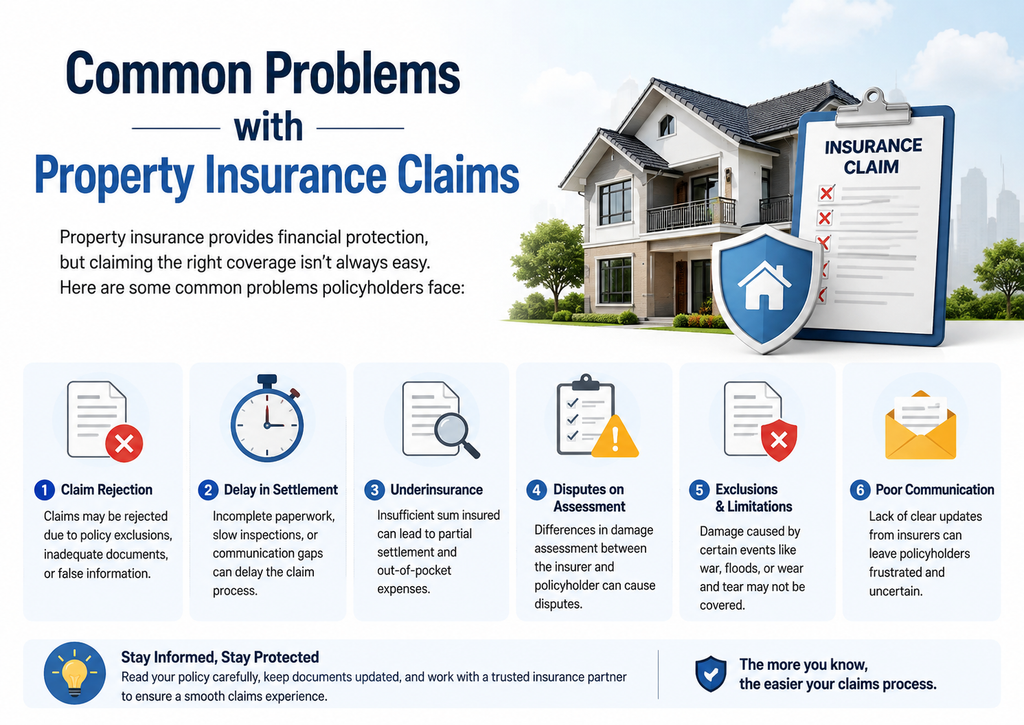
Property insurance claims can become complicated because the outcome depends on the policy wording, nature of the damage, exclusions, documentation, valuation, and the circumstances surrounding the loss.
Below are some of the common problems associated with property insurance claims.
1. Claim Rejection
One of the most serious problems is the rejection of a property insurance claim.
An insurer may reject a claim when it determines that the reported loss does not fall within the policy coverage or that a specific policy condition has not been met. The reason for rejection can vary depending on the type of property, policy terms, and circumstances of the incident.
A rejection does not necessarily mean that the policyholder expected the same interpretation of the policy. Differences in understanding the policy wording can sometimes lead to disputes.
2. Claim Settlement Delays
Property claims can sometimes take considerable time to settle, particularly when the damage is extensive or the loss requires detailed assessment.
For example, a large commercial property loss may involve building damage, machinery, stock, furniture, equipment, and business-related losses. Assessing each component can make the claim more complex.
Delays may also arise because of inspections, estimates, surveys, documentation, or disagreements regarding the extent of the loss.
3. Disputes Over the Amount of Loss
Another common issue is disagreement over the value of the damage.
The policyholder may estimate the loss at a particular amount, while the insurer or surveyor may assess it differently. Differences can occur because of depreciation, repair costs, replacement values, market prices, or the method used to calculate the loss.
As a result, the amount offered during settlement may be lower than what the policyholder expected.
4. Underinsurance
Underinsurance can become a significant problem when the insured value of the property is lower than its actual value.
For example, if a building is insured for an amount substantially below its actual reconstruction cost, the policy may not provide sufficient financial protection for a major loss.
This issue is particularly important for commercial properties, where construction costs, machinery, equipment, inventory, and other assets can change significantly over time.
5. Policy Exclusions
Every property insurance policy contains exclusions. These are situations, risks, or types of losses that the policy does not cover.
Common exclusions can vary between policies and may relate to particular causes of damage, maintenance issues, wear and tear, certain natural events, negligence, or other specified circumstances.
A claim may therefore become disputed when the insurer believes that the cause or nature of the damage falls under an exclusion.
6. Disputes About the Cause of Damage
Determining what caused the damage can be an important part of a property insurance claim.
For instance, damage to a building could result from water leakage, flooding, structural problems, poor maintenance, a storm, or another event. The cause can influence whether the loss falls within the policy coverage.
When the policyholder and insurer have different views about the cause of the damage, the claim may become difficult to settle.
7. Depreciation and Valuation Issues
The value of damaged property is not always calculated simply by considering its original purchase price.
Depending on the policy, factors such as age, condition, depreciation, replacement cost, and market value may influence the settlement amount.
This can create a difference between the amount a policyholder expects and the amount considered payable under the policy.
8. Documentation-Related Issues
Property claims often involve substantial documentation.
Depending on the nature of the loss, information may relate to ownership, property value, repairs, purchases, inventory, damaged assets, invoices, photographs, estimates, or other records.
Missing, inconsistent, or incomplete information can make the assessment of a property claim more complicated and may contribute to delays or disagreements.
9. Partial Claim Settlement
Not every disputed claim ends with a complete rejection.
Sometimes an insurer may accept part of the claim while disputing other components of the loss. This can result in a partial settlement.
For example, some damaged items may be considered covered while others may be excluded. Similarly, the insurer may accept the damage but calculate its value differently.
This can lead to a short-settlement dispute when the policyholder believes the amount offered does not adequately reflect the covered loss.
10. Survey and Assessment Disputes
Property insurance claims often involve assessment of the damage and the financial value of the loss.
Differences may arise regarding the extent of damage, repair requirements, replacement costs, depreciation, or whether particular items were affected by the insured event.
When the assessment differs significantly from the policyholder’s understanding of the loss, settlement discussions can become complicated.
11. Business Interruption-Related Issues
For commercial property owners, damage to physical property may also affect business operations.
A business may experience lost income because its premises cannot operate normally following an insured event. Whether such losses are covered depends on the policy and the applicable business interruption provisions.
Disagreements can arise over the calculation of lost income, the period of interruption, or whether the particular loss falls within the policy’s coverage.
12. Repair and Replacement Cost Disputes
Another common issue concerns the cost of repairing or replacing damaged property.
The policyholder may receive an estimate from a contractor that differs from the amount considered reasonable by the insurer or its appointed assessor.
Differences can involve labour costs, materials, construction methods, replacement specifications, or prevailing market rates.
13. Maintenance vs. Insured Damage
Property insurance generally focuses on losses caused by insured events rather than ordinary deterioration.
Problems such as ageing, gradual deterioration, poor maintenance, or wear and tear can therefore create disputes when they appear to contribute to the damage.
A key question may be whether the reported loss resulted from a sudden insured event or from a condition that developed over time.
14. Multiple Causes of Loss
Sometimes property damage has more than one contributing cause.
For example, a building could experience damage where weather conditions, water intrusion, structural weaknesses, and maintenance issues are all involved.
When several causes are present, determining which cause is responsible for the insured loss can become particularly complicated.
15. Differences in Policy Interpretation
Insurance policies contain detailed definitions, conditions, exclusions, limits, and coverage provisions.
The meaning of particular terms can sometimes be interpreted differently by the policyholder and insurer. These differences can influence whether a particular loss is covered and how much may be payable.
This is one reason why understanding the actual policy wording is important when considering property insurance coverage.
Conclusion
Property insurance claims can involve much more than simply reporting damage and receiving compensation. Claim rejection, settlement delays, valuation differences, underinsurance, exclusions, documentation issues, partial settlements, and disputes about the cause of damage are among the common challenges policyholders may encounter.
The outcome of a property insurance claim ultimately depends on the specific policy wording, coverage, exclusions, circumstances of the loss, and assessment of the damage. Understanding these factors can help property owners better understand why claims sometimes become disputed or take longer than expected.
Insurance Resolve helps policyholders understand insurance-related problems, including property claim disputes, claim delays, claim rejection, and settlement concerns.
📞 Phone: +91 99103 52249
📧 Email: help@insuranceresolve.com
🌐 Website: www.insuranceresolve.com

