

Health insurance is intended to provide financial protection against medical expenses, but having a health insurance policy does not necessarily mean that every medical expense will be covered.
Health insurance claims are assessed according to the policy terms, coverage limits, exclusions, waiting periods, medical conditions, and other applicable conditions. Understanding these important facts can help customers have a clearer idea of what their health insurance policy covers.
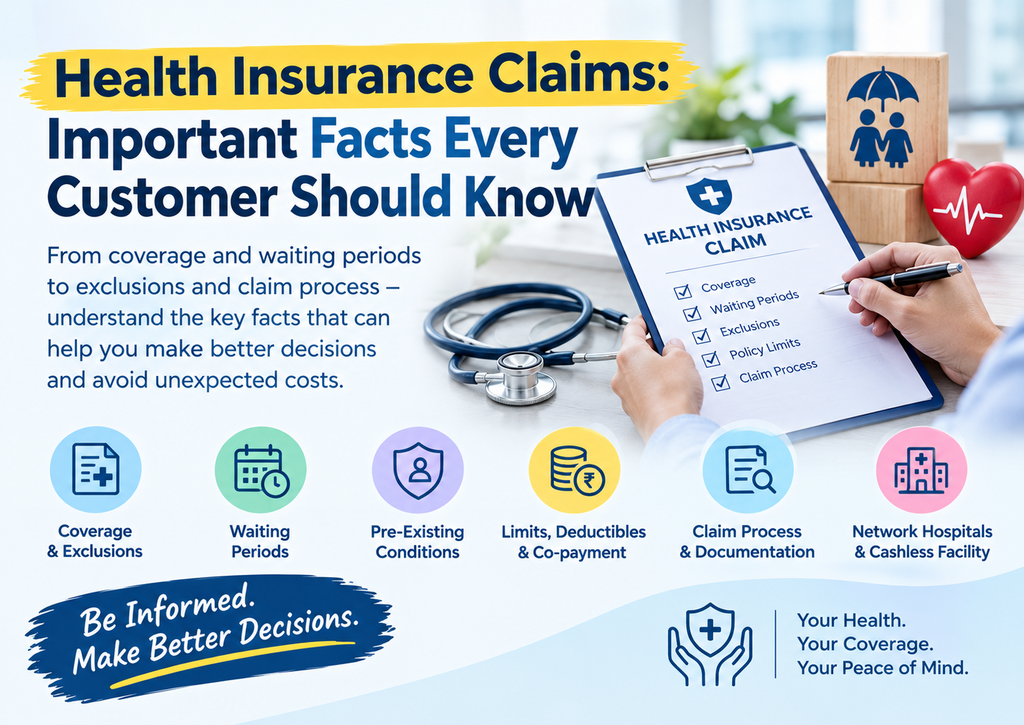
What Is a Health Insurance Claim?
A health insurance claim is a request made by the policyholder or an authorised healthcare provider to the insurer for payment or reimbursement of eligible medical expenses under the insurance policy.
Depending on the policy and treatment, a claim may be handled through cashless treatment at an eligible network hospital or through reimbursement of eligible expenses.
Cashless and Reimbursement Claims
Health insurance claims are commonly associated with two types of settlement.
Cashless Claim:
Under a cashless arrangement, eligible treatment expenses may be settled directly between the insurer or its authorised claims administrator and a network hospital, subject to policy terms and approval.
Reimbursement Claim:
Under reimbursement, the policyholder may initially pay the medical expenses and subsequently submit the relevant claim documents for assessment and reimbursement of eligible expenses.
The exact process and availability of these facilities depend on the insurance policy and healthcare provider.
Not Every Medical Expense Is Covered
One of the most important facts about health insurance is that coverage is subject to policy conditions.
Expenses may not be payable when they fall under exclusions, exceed applicable limits, relate to non-covered services, or otherwise do not satisfy the terms of the policy.
Therefore, the existence of a health insurance policy does not automatically guarantee payment for every hospital or medical expense.
Waiting Periods Can Affect Claims
Many health insurance policies contain waiting periods for certain treatments, illnesses, or pre-existing conditions.
A claim related to a condition subject to a waiting period may not be payable until the applicable waiting period has been completed.
Understanding waiting-period provisions is particularly important when purchasing health insurance.
Pre-Existing Diseases May Have Specific Conditions
Health insurance policies may treat pre-existing diseases differently from newly developed medical conditions.
Depending on the policy, a pre-existing condition may have a specific waiting period or other coverage conditions. Accurate disclosure of relevant medical information is therefore an important aspect of health insurance.
Policy Limits Can Affect Claim Payments
Health insurance policies may contain various limits, such as the sum insured, room-rent limits, sub-limits, disease-specific limits, or other benefit restrictions.
Even when a treatment is covered, the amount payable by the insurer may be affected by these limits.
This can result in the policyholder having to bear part of the medical expense.
Co-Payment Can Increase Out-of-Pocket Expenses
Some health insurance policies include a co-payment provision.
Under a co-payment arrangement, the policyholder is responsible for a specified portion of eligible medical expenses, while the insurer pays the remaining eligible amount according to the policy terms.
Consequently, the final amount payable by the policyholder can be higher than expected if the co-payment condition is not understood.
Deductibles Also Matter
A deductible is an amount that the policyholder may have to bear before the insurer becomes responsible for the eligible portion of a claim.
The deductible can influence the amount ultimately payable by the insurer and the policyholder’s out-of-pocket expenses.
Policy Exclusions Are Important
Health insurance policies contain exclusions that identify treatments, conditions, expenses, or circumstances that are not covered.
Examples can include certain non-medical expenses, specific treatments, cosmetic procedures under applicable exclusions, or other conditions defined by the policy.
The exact exclusions vary between policies, so customers should not assume that an expense excluded under one policy is excluded under every health insurance policy.
Claim Approval Is Based on Policy Terms
A claim is generally assessed based on the circumstances of the treatment and the applicable policy terms.
Factors such as coverage, medical records, policy status, waiting periods, exclusions, limits, and other conditions may be considered during claim assessment.
As a result, a claim may be approved, partially approved, delayed, or rejected, depending on the circumstances and policy provisions.
Documentation Can Be Important
Health insurance claims may involve documents such as medical records, hospital bills, prescriptions, diagnostic reports, discharge summaries, and other relevant information.
The documentation required can vary depending on the nature of the claim and the insurer’s requirements.
Incomplete or inconsistent information may lead to additional queries or delays in claim assessment.
Network Hospitals and Cashless Facilities
Network hospitals are healthcare providers that have an arrangement with an insurer or claims administrator for applicable cashless services.
However, cashless availability does not necessarily mean that every expense will be covered. Eligible expenses remain subject to the policy’s terms, limits, exclusions, and applicable approval.
Claim Delays and Claim Rejection Are Different
A claim delay means the claim has not yet been settled and additional assessment, verification, or information may be pending.
A claim rejection means the insurer has determined that the claim or a particular portion of it is not payable under the applicable policy terms.
Understanding this difference is important when evaluating the status of a health insurance claim.
Health Insurance Renewals and Continuity
Maintaining continuity of health insurance can be important because certain benefits, waiting periods, and accumulated policy features may depend on continuous coverage.
Allowing a policy to lapse can affect the protection available during a period when the policy is inactive.
Why Understanding Your Health Insurance Policy Matters
Health insurance can involve several conditions beyond the basic coverage amount. Waiting periods, exclusions, sub-limits, co-payment, deductibles, network arrangements, and claim conditions can all influence the final amount payable.
A clear understanding of these provisions helps customers have realistic expectations about their health insurance coverage.
Conclusion
Health insurance claims are governed by the terms and conditions of the applicable insurance policy. Coverage is not determined only by the fact that a medical treatment has taken place.
Important factors such as waiting periods, exclusions, policy limits, deductibles, co-payment, pre-existing conditions, documentation, and claim assessment can influence whether and how much a claim is paid.
Being aware of these facts can help health insurance customers better understand their coverage and make more informed decisions about their financial protection.
📞 Call: 99103-52249
📧 Email: help@insuranceresolve.com
🌐 Website: www.insuranceresolve.com

