

Insurance claims can end in different ways depending on the policy terms, circumstances of the loss, and assessment carried out by the insurer. Two terms that are often confused are claim rejection and claim short settlement.
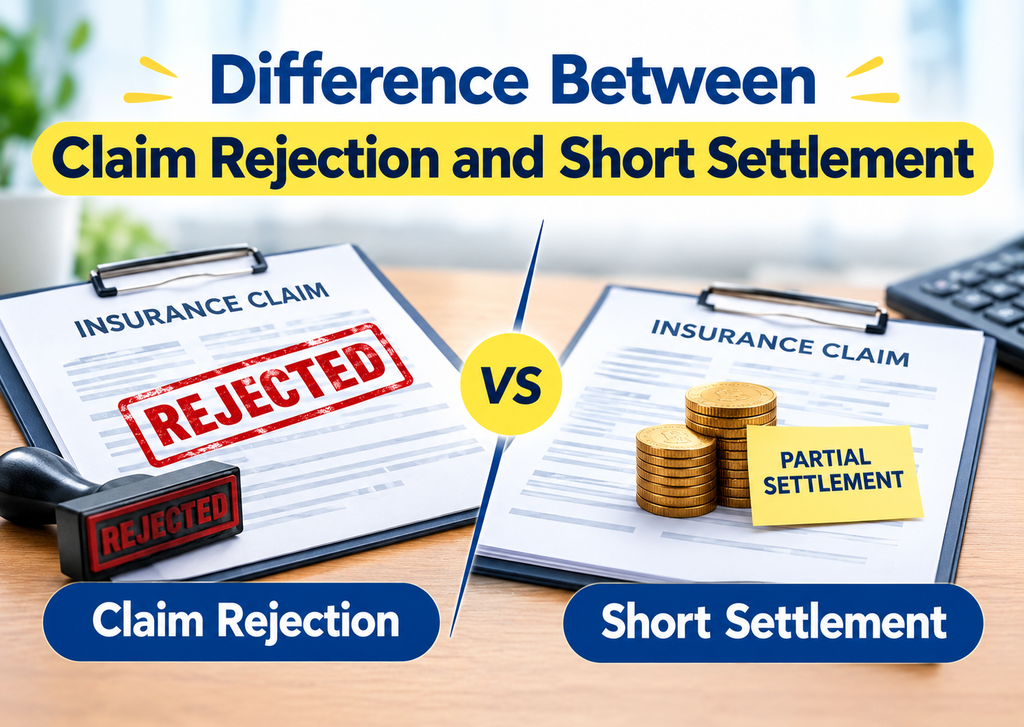
Although both can result in a policyholder receiving less money than expected, they represent different claim outcomes.
What Is Claim Rejection?
Claim rejection, also known as claim repudiation in certain contexts, means the insurer does not accept the claim for payment.
A rejected claim generally results in no claim amount being paid for the particular loss.
The reason for rejection may relate to policy exclusions, lack of coverage, policy conditions, non-disclosure of relevant information, or other circumstances covered by the policy terms.
What Is Claim Short Settlement?
A short-settled claim is a claim where the insurer accepts liability for the loss but pays an amount that is lower than the amount claimed or expected by the policyholder.
For example, if a policyholder submits a claim for ₹5 lakh and the insurer determines that only ₹3.5 lakh is payable under the applicable policy terms, the claim may be settled for ₹3.5 lakh.
The difference does not automatically mean that the insurer has acted incorrectly. It may result from policy limits, deductibles, depreciation, exclusions applicable to particular items, underinsurance, or assessment of the actual covered loss.
Claim Rejection vs Short Settlement
| Claim Rejection | Short Settlement |
|---|---|
| The claim is not accepted for payment | The claim is accepted for a specified amount |
| Generally results in no payment | Results in partial payment |
| The insurer considers the claim outside applicable coverage or otherwise not payable | The insurer determines that only part of the claimed amount is payable |
| May involve exclusions, conditions, or coverage issues | May involve valuation, limits, deductibles, depreciation, or other policy provisions |
Why Can an Insurance Claim Be Rejected?
A claim may be rejected when the reported loss does not fall within the coverage provided by the policy.
Common circumstances can include an excluded event, an applicable policy condition, a loss occurring outside the policy period, or circumstances that do not satisfy the requirements of the insurance contract.
The specific reason should be considered against the policy wording and the facts of the claim.
Why Can an Insurance Claim Be Short Settled?
Short settlement can occur when the amount payable under the policy is lower than the amount claimed.
For example, a policy may contain a sum insured or sub-limit that restricts the maximum payable amount. A deductible may also reduce the final settlement.
In property insurance, depreciation or underinsurance can also affect the amount payable. In health insurance, applicable co-payments, sub-limits, deductibles, or exclusions may affect the final amount.
Role of Policy Terms
The policy document is central to both claim rejection and short settlement.
Insurance policies contain definitions, coverage limits, exclusions, deductibles, conditions, warranties, and other provisions that determine the insurer’s obligations.
Therefore, the amount originally claimed by the policyholder does not necessarily represent the amount payable under the insurance contract.
Can a Short-Settled Claim Be Different From a Rejected Claim?
Yes.
A rejected claim means that the insurer has not accepted the claim for payment. A short-settled claim means that the insurer has accepted some liability and paid a portion of the amount claimed.
The two situations can therefore involve different reasons, assessments, and policy provisions.
Understanding the Claim Decision
A claim decision should be understood from the insurer’s stated reason and the applicable policy provisions.
For a rejection, the relevant question is generally why the insurer considers the loss outside the payable coverage.
For a short settlement, the focus is generally on how the insurer calculated the payable amount and which policy provisions affected the settlement.
Final Thoughts
Claim rejection and short settlement are two different insurance claim outcomes.
Claim rejection generally means that the claim is not accepted for payment, while short settlement means that the claim is accepted but the amount paid is lower than the amount claimed.
The difference between the claimed amount and the settled amount does not by itself establish whether a settlement is correct. The applicable policy terms, exclusions, limits, deductibles, valuation, and evidence relating to the loss are important when understanding the final claim decision.
Contact Insurance Resolve
Insurance Resolve
📞 Phone: +91 9910352249
📧 Email: help@insuranceresolve.com
🌐 Website: https://insuranceresolve.com/

