

The terms insurance rejection and claim rejection are sometimes used interchangeably, but they can refer to different situations.
Understanding the difference is important because an insurance policy can face an issue at different stages — before the policy is issued, during policy servicing, or when a claim is submitted.
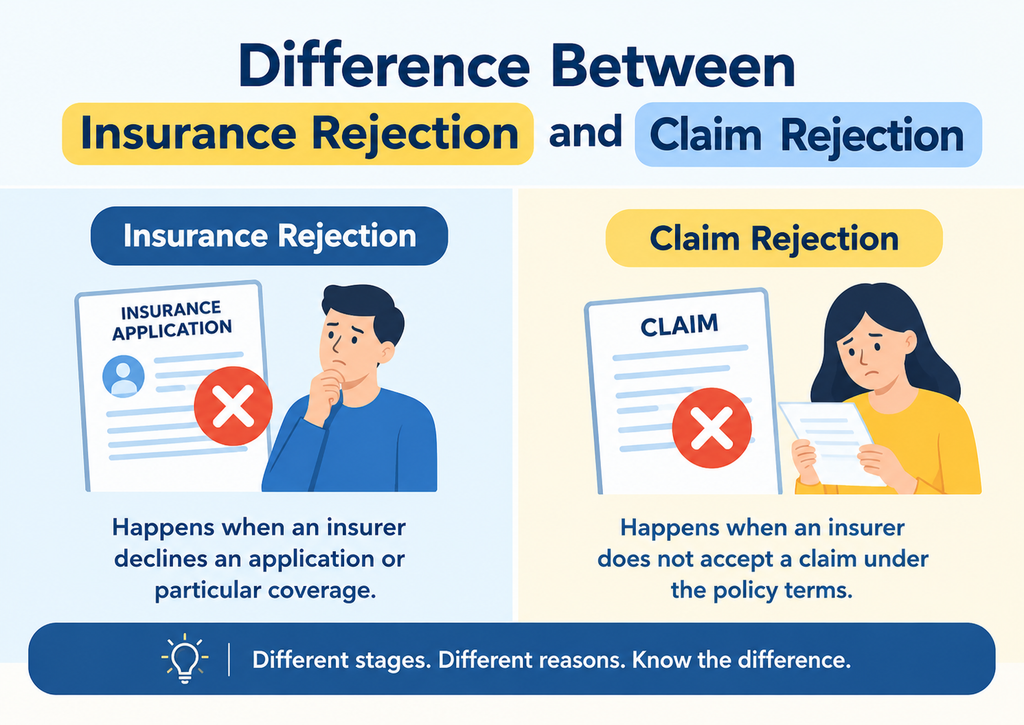
What Is Insurance Rejection?
“Insurance rejection” is a broad term that can refer to an insurer declining an insurance application, request, or particular coverage.
For example, an insurance company may decide not to issue a policy based on its underwriting rules, the information provided in the application, or the risk involved.
The exact reason depends on the type of insurance and the circumstances.
What Is Claim Rejection?
Claim rejection occurs when an insurer does not accept a claim for payment under the applicable policy terms.
A claim may be rejected because the circumstances of the loss do not fall within the coverage, an exclusion applies, a policy condition is not satisfied, or for another reason specified by the insurer and supported by the applicable policy terms.
A claim rejection therefore generally occurs after a claim has been made.
The Main Difference
The simplest way to understand the distinction is:
Insurance rejection can relate to the insurance application or coverage itself.
Claim rejection relates specifically to a claim submitted under an insurance policy.
The two situations occur at different stages and can involve different reasons.
Insurance Application Rejection
Before an insurance policy is issued, an insurer assesses the information provided by the applicant and the risk involved.
Depending on the product and underwriting rules, an application may not be accepted.
Possible factors can include:
- Information provided in the application
- Risk characteristics
- Previous insurance history
- Medical or financial information, where relevant to the product
- Underwriting guidelines
- Product eligibility requirements
The applicable reasons and requirements differ between insurance products.
Claim Rejection
A claim rejection is concerned with a loss or event for which the policyholder has requested payment.
The insurer may examine the policy coverage, exclusions, conditions, documents, and circumstances surrounding the claim.
For example, a claim may be disputed where the insurer determines that the event is outside the policy coverage or falls within an applicable exclusion.
Insurance Rejection Does Not Mean Claim Rejection
These terms should not automatically be treated as the same.
If an insurance application is not accepted, there may be no policy and therefore no claim under that policy.
A claim rejection, on the other hand, generally concerns an existing policy under which a claim has been submitted.
Reasons for Claim Rejection Can Be Different From Application Rejection
The reasons involved at the two stages are different.
An application decision generally relates to whether the insurer will provide the requested insurance under its underwriting and eligibility criteria.
A claim decision generally relates to whether the particular loss or event is covered under the existing policy.
This distinction is important when discussing an insurance-related dispute.
Claim Rejection and Policy Exclusions
One common issue in claim disputes involves exclusions.
An exclusion identifies a situation, loss, or circumstance that is outside the policy’s coverage.
If an insurer relies on an exclusion while rejecting a claim, the relevant policy wording and the circumstances of the claim are important for understanding the decision.
Claim Rejection and Policy Conditions
Insurance policies also contain conditions that can affect coverage and claims.
These may relate to matters such as information provided by the policyholder, policy requirements, documentation, notification, or other contractual provisions.
The specific conditions vary according to the policy.
Rejection Is Different From Short Settlement
A claim rejection generally means that the insurer has declined the claim rather than paying the claimed amount.
A short settlement, however, means that the insurer has accepted the claim to some extent but has offered or paid an amount lower than what the policyholder expected or claimed.
These are different types of claim-related situations.
Rejection Is Also Different From Claim Delay
A delayed claim is another separate situation.
A claim may remain under assessment or investigation for a period of time without a final rejection decision.
Therefore:
- Application/insurance rejection: Insurance coverage may not be accepted.
- Claim rejection: A submitted claim is declined.
- Claim delay: A claim decision has not been completed within the relevant circumstances.
- Short settlement: A claim is accepted but the amount paid or offered is lower than expected.
Why Understanding the Difference Matters
Using the correct terminology can make an insurance concern easier to understand.
A policyholder dealing with an application issue has a different situation from someone whose existing claim has been rejected.
Similarly, a rejected claim is different from a delayed claim or a short-settled claim.
Understanding which situation applies can help in reviewing the relevant policy documents, communications, and reasons provided by the insurer.
Final Thoughts
Insurance rejection and claim rejection are related but different concepts.
Insurance rejection can refer broadly to an insurer declining an application or particular coverage, while claim rejection specifically concerns a claim made under an insurance policy.
When a claim is rejected, the policy wording, coverage, exclusions, conditions, and circumstances of the claim are important for understanding the decision. A Claim Settlement Ratio or general reputation of an insurer does not by itself determine whether an individual claim is payable.
Need Help With an Insurance Concern?
Insurance Resolve helps policyholders understand and address concerns related to claim rejection, claim delays, short settlement, insurance mis-selling, and service issues.
Website: www.insuranceresolve.com
Email: help@insuranceresolve.com
Phone: +91 9910352249
