
Insurance claims involve financial losses, and documents play an important role in helping an insurer understand the circumstances of a claim. The documents required can vary depending on the type of insurance, nature of the loss, policy conditions, and the amount involved.
Different insurance claims may require different types of supporting records. A motor insurance claim, for example, may involve vehicle-related documents, while a property or marine insurance claim may require invoices, ownership records, assessment reports, or transportation documents.
Understanding the types of documents commonly associated with insurance claims provides policyholders with a clearer picture of the information insurers may consider while assessing a claim.
Why Are Documents Important in an Insurance Claim?
Insurance companies need relevant information to determine whether a reported loss falls within the policy coverage.
Documents can help establish:
- The identity of the policyholder.
- The existence of the insured property or asset.
- The occurrence of the insured event.
- The date and circumstances of the loss.
- The extent of the damage or financial loss.
- The value of the affected property.
- Ownership or financial interest in the property.
- Other facts relevant to the insurance claim.
The exact documentation depends on the policy and the nature of the claim.
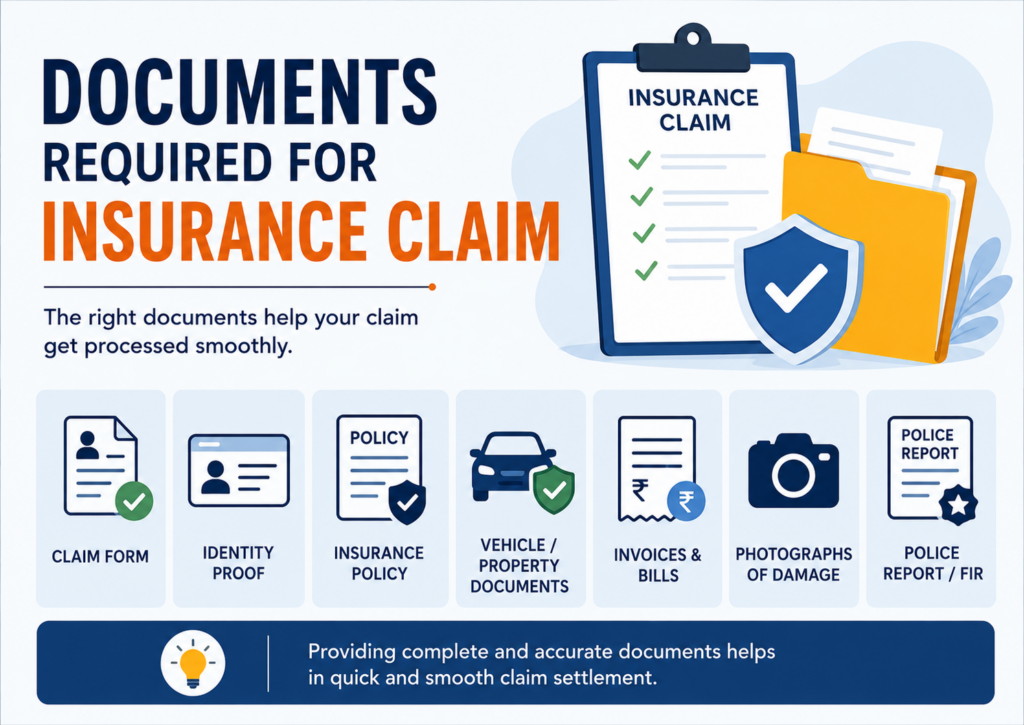
Common Documents Associated With Insurance Claims
Although requirements vary, several documents are commonly associated with different types of insurance claims.
Insurance Policy Document
The insurance policy is one of the most important documents because it contains information about coverage, exclusions, policy limits, deductibles, insured property, conditions, and other contractual provisions.
The insurer may refer to the policy while determining whether a particular loss is covered.
Claim Form
A claim form contains information about the insured event and the loss being reported.
It may include details such as the policy number, date of incident, nature of loss, estimated loss amount, and other relevant information.
Identity and Address Proof
Identity and address documents may be relevant for verifying the policyholder and other claim-related information.
The exact documents accepted can vary depending on the insurer and type of claim.
Policyholder’s Bank Details
Bank account information may be relevant when an approved claim settlement is payable directly to the policyholder.
The exact requirements depend on the insurer and the nature of the settlement.
Documents for Motor Insurance Claims
Motor insurance claims may require documents relating to the vehicle, driver, accident, and damage.
Commonly associated documents can include:
- Motor insurance policy.
- Vehicle Registration Certificate (RC).
- Driving licence.
- Identity documents.
- Repair estimates.
- Vehicle photographs.
- FIR or police documents where applicable.
- Other accident-related records.
- Survey or inspection reports where applicable.
The actual documentation depends on the type and circumstances of the motor claim.
Documents for Property Insurance Claims
Property insurance claims can involve damage to buildings, contents, machinery, stock, furniture, or other insured assets.
Relevant documents may include:
- Property insurance policy.
- Ownership or possession records.
- Purchase invoices.
- Repair estimates.
- Photographs or videos of damage.
- Fire or police reports where applicable.
- Asset registers.
- Stock records.
- Surveyor or assessment reports.
- Other evidence relating to the loss.
Commercial property claims can involve additional financial and business records.
Documents for Fire Insurance Claims
Fire claims may require information that helps establish the occurrence and extent of the fire-related loss.
Depending on the circumstances, documents can include:
- Fire insurance policy.
- Fire brigade report.
- FIR or police report where applicable.
- Photographs of the affected property.
- Repair or replacement estimates.
- Purchase invoices.
- Stock records.
- Asset records.
- Financial records.
- Survey or loss assessment reports.
The specific requirements depend on the policy and nature of the fire loss.
Documents for Marine Insurance Claims
Marine insurance claims can involve goods transported by sea, road, rail, air, or combined transportation.
Documents associated with marine claims may include:
- Marine insurance policy.
- Invoice.
- Packing list.
- Bill of Lading or transport document.
- Shipping documents.
- Delivery records.
- Purchase documents.
- Photographs of damaged goods.
- Survey report.
- Damage or shortage certificate.
- Other transportation-related records.
The required documentation can vary depending on the type of cargo, transportation method, and nature of the loss.
Documents for Commercial Insurance Claims
Commercial insurance claims can involve significant business assets, property, inventory, machinery, or financial losses.
Relevant documents may include:
- Commercial insurance policy.
- Purchase invoices.
- Asset registers.
- Stock records.
- Accounting records.
- Repair estimates.
- Financial statements.
- Photographs or videos.
- Police or fire reports where applicable.
- Business interruption records where applicable.
- Survey or assessment reports.
The documentation for a commercial claim can be more extensive because the financial value and complexity of the loss may be higher.
Documents for Theft Claims
Theft-related insurance claims can require documents establishing the occurrence of the theft and the value and ownership of the affected property.
Depending on the insurance policy, relevant documents may include:
- Insurance policy.
- FIR or police complaint.
- Purchase invoices.
- Ownership documents.
- Inventory records.
- Photographs or identification records.
- Other evidence relating to the stolen property.
The actual requirements depend on the policy and type of insured property.
Documents for Partial Loss Claims
When only part of the insured property is damaged, documents may be required to establish the extent and value of the damage.
These can include:
- Damage photographs.
- Repair estimates.
- Replacement quotations.
- Purchase invoices.
- Asset records.
- Survey reports.
- Other evidence relating to the damaged property.
Documents for Total Loss Claims
Total loss claims can involve situations where the insured property is completely destroyed, lost, or considered beyond economical repair, depending on the insurance type.
Documents may include:
- Insurance policy.
- Ownership records.
- Purchase documents.
- Identification documents.
- Police reports where applicable.
- Assessment or survey reports.
- Other documents relevant to establishing the loss.
The meaning of total loss differs between insurance products.
Documents and Proof of Ownership
Proof of ownership or financial interest can be important when a claim involves property, equipment, vehicles, stock, machinery, or other valuable assets.
Examples can include:
- Purchase invoices.
- Registration documents.
- Bills of sale.
- Asset registers.
- Ownership certificates.
- Inventory records.
- Other relevant commercial records.
The purpose of such documents is generally to establish the policyholder’s interest in the insured property.
Documents and Proof of Loss
Insurance claims also require information showing that a loss actually occurred and establishing its extent.
Depending on the situation, proof of loss may include:
- Photographs.
- Videos.
- Repair estimates.
- Invoices.
- Survey reports.
- Police reports.
- Fire reports.
- Medical or other relevant records where applicable.
- Financial records.
The evidence required depends on the nature of the claim.
What Happens When Documents Are Missing?
Missing documents can sometimes make it more difficult for an insurer to assess a claim.
However, the effect of missing documentation depends on the nature of the document, the policy requirements, and whether other evidence can establish the relevant facts.
A missing document does not automatically mean that every claim will be rejected. The significance of the missing information depends on the individual circumstances.
Can Incorrect Documents Affect an Insurance Claim?
Yes. Incorrect, inconsistent, altered, or misleading information can affect the assessment of an insurance claim.
Insurance companies may compare information across different documents to determine whether the reported circumstances and financial loss are consistent.
Material discrepancies can create questions about the validity or value of a claim.
Documents and Claim Settlement
Documents can influence the insurer’s assessment of the amount payable under a policy.
For example, invoices may help establish the value of damaged property, while repair estimates can help determine the cost of restoring an insured asset.
The final settlement can also be affected by policy limits, deductibles, depreciation, exclusions, valuation methods, and other policy conditions.
Documents Required Can Differ by Insurance Type
There is no single document list that applies to every insurance claim.
The requirements can differ based on:
- Type of insurance.
- Nature of the loss.
- Value of the claim.
- Type of insured property.
- Policy conditions.
- Circumstances of the incident.
- Applicable legal requirements.
- Insurer’s claim assessment.
Therefore, the documents relevant to one type of claim may not be relevant to another.
Insurance Resolve – Insurance Claim & Complaint Solutions
Insurance Resolve helps policyholders understand insurance-related concerns, including claim rejection, claim delays, short-settled claims, documentation-related concerns, insurance mis-selling, lapsed policies, service issues, and other insurance problems.
The objective is to provide greater clarity regarding insurance policies, claim decisions, and insurance-related concerns.
📞 Phone: +91 99103 52249
📧 Email: help@insuranceresolve.com
🌐 Website: www.insuranceresolve.com

