

Travel insurance provides financial protection against specified risks that may occur during a trip, such as medical emergencies, baggage loss, trip cancellation, travel delays, and other covered events. However, not every travel-related loss is automatically covered.
A travel insurance claim rejection occurs when the insurer determines that the reported loss or expense does not fall within the coverage provided by the policy.
Understanding the common reasons for travel insurance claim rejection can help travellers better understand their policy coverage and limitations.
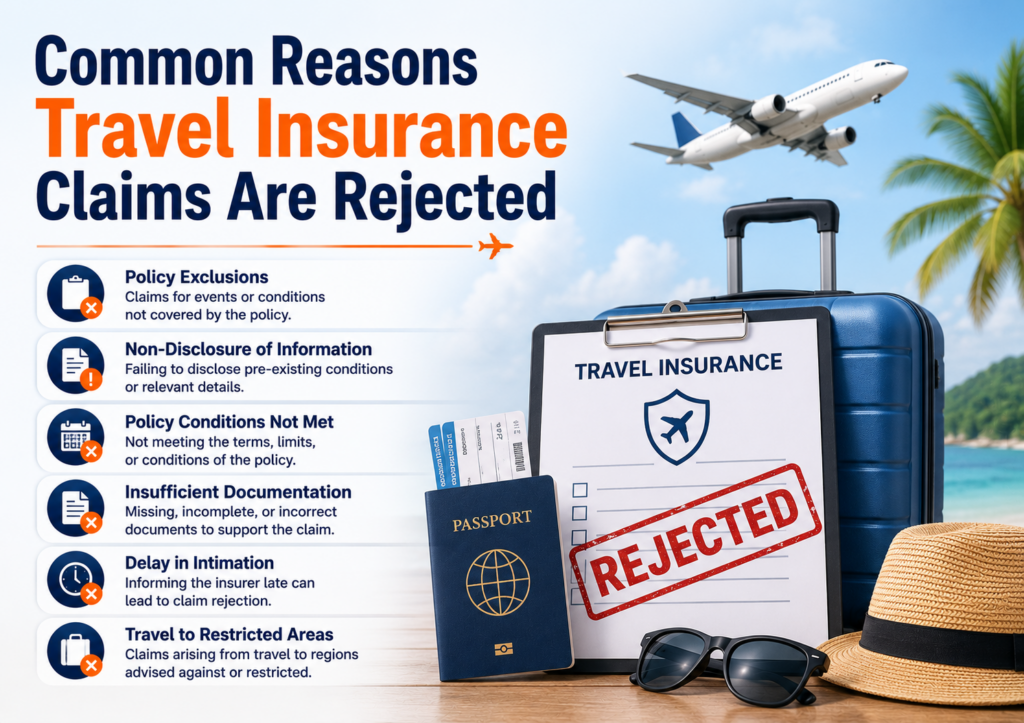
The Event Is Not Covered by the Policy
Travel insurance policies specify the situations and risks for which coverage is available.
If an incident does not fall within the insured risks, the related claim may not be payable. For example, a policy may cover cancellation for certain specified reasons but not every type of voluntary cancellation.
Policy Was Not Active
Travel insurance coverage applies according to the policy period and journey dates specified in the policy.
If an event occurs outside the applicable coverage period, the insurer may determine that the loss is not covered.
Pre-Existing Medical Conditions
Medical coverage is an important part of many travel insurance policies, but pre-existing medical conditions may have specific exclusions or limitations.
If a medical expense is related to a condition that falls under an applicable exclusion, the claim may be rejected or coverage may be limited.
Medical Treatment Is Not Covered
Not every medical expense incurred during travel is necessarily covered.
Certain treatments, procedures, medications, or medical circumstances may be excluded or subject to specific policy conditions.
The insurer assesses whether the medical expense falls within the applicable coverage.
Trip Cancellation Reason Is Excluded
Travel insurance may provide cancellation coverage for specific circumstances.
If a traveller cancels a trip for a reason that is not included in the policy, the related cancellation expense may not be payable.
Loss or Delay of Baggage Does Not Meet Policy Conditions
Travel insurance can provide benefits for eligible baggage loss, theft, or delay.
However, coverage may depend on the circumstances of the loss, applicable limits, exclusions, and policy conditions.
Certain personal belongings may also have individual limits or exclusions.
Inadequate Supporting Evidence
A claim may require sufficient information to establish the nature and value of the loss.
If the circumstances or amount of a claimed loss cannot be adequately established, it may affect the insurer’s assessment.
This does not automatically mean every claim with incomplete information will be rejected; the outcome depends on the individual circumstances.
Risky Activities Are Excluded
Some travel insurance policies contain exclusions for certain high-risk activities.
For example, adventure sports or other hazardous activities may require specific coverage. If an incident occurs during an excluded activity, the claim may not be payable.
Violation of Policy Conditions
Travel insurance policies contain conditions relating to the insured journey and coverage.
A significant violation of an applicable condition may affect the insurer’s liability depending on the circumstances and policy wording.
Fraudulent or Misleading Information
Insurance coverage depends on accurate information.
If an insurer finds that information relating to a claim was deliberately falsified, misleading, or fraudulent, the claim can face rejection and other consequences under the policy and applicable law.
Travel Insurance Claim Rejection vs Partial Settlement
A claim rejection means the insurer determines that the claim is not payable under the applicable policy.
A partial settlement means the insurer accepts liability for part of the loss but pays less than the amount claimed.
Partial settlement may occur because of policy limits, deductibles, exclusions, benefit-specific limits, or other policy conditions.
Insurance Resolve – Travel Insurance Solutions
Insurance Resolve helps policyholders understand insurance concerns, including travel insurance claim rejection, claim delays, short-settled claims, insurance mis-selling, policy disputes, service issues, and other insurance problems.
📞 Phone: +91 99103 52249
📧 Email: help@insuranceresolve.com
🌐 Website: www.insuranceresolve.com
Frequently Asked Questions
Why are travel insurance claims rejected?
Claims may be rejected because the event is not covered, the policy was inactive, an exclusion applies, a pre-existing condition is involved, or other policy conditions are not satisfied.
Does travel insurance cover all medical expenses?
No. Medical coverage depends on the policy’s insured risks, exclusions, limits, and conditions.
Can a pre-existing disease affect a travel insurance claim?
Yes. Pre-existing medical conditions may be excluded or subject to specific limitations under the policy.
Can a travel insurance claim be rejected for baggage loss?
Yes. Baggage claims are subject to specific coverage, limits, exclusions, and conditions.
Does travel insurance cover every reason for trip cancellation?
No. Cancellation coverage generally applies only to specified covered reasons mentioned in the policy.
What is the difference between travel insurance claim rejection and short settlement?
Rejection means the claim is determined to be non-payable, while short settlement means only part of the claimed amount is accepted and paid.
Conclusion
Travel insurance claims can be rejected for various reasons, including exclusions, inactive coverage, pre-existing medical conditions, uncovered cancellation reasons, baggage-related conditions, excluded activities, insufficient evidence, and policy violations.
The final decision depends on the policy wording, coverage, exclusions, limits, and circumstances of the claim. Understanding these provisions helps travellers better understand the actual protection available under their travel insurance policy.

