

Fire insurance provides financial protection against covered losses caused by fire and other insured events. However, having a fire insurance policy does not mean every fire-related loss will automatically be paid.
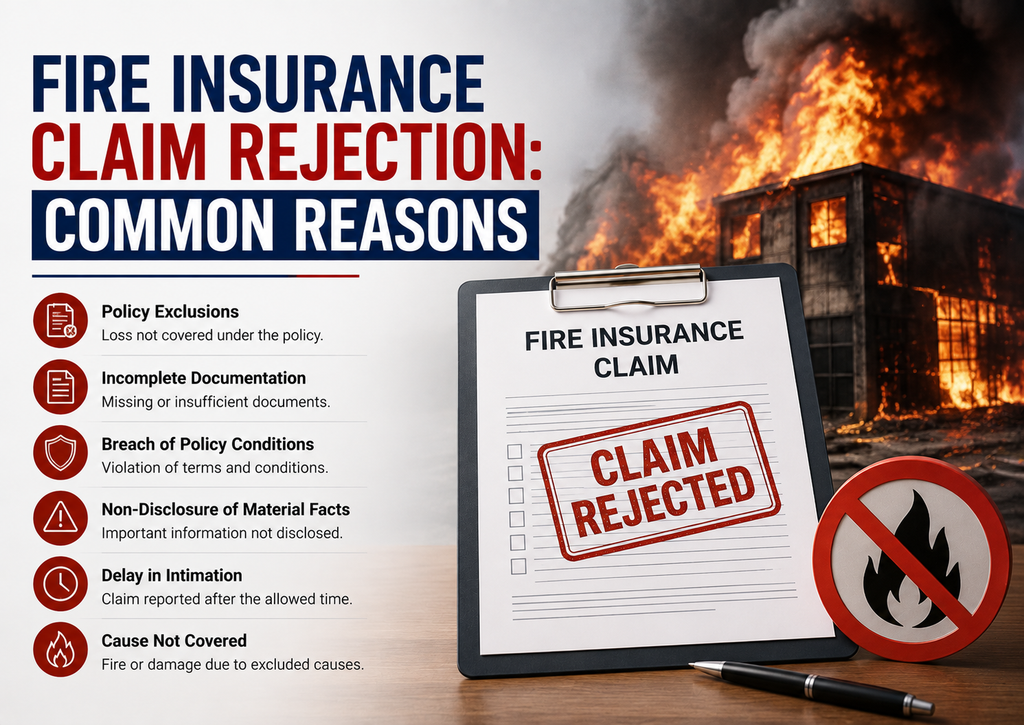
A fire insurance claim may be rejected when the insurer determines that the loss falls outside the policy coverage or that applicable policy conditions have not been met.
Common Reasons for Fire Insurance Claim Rejection
The Cause of Loss Is Not Covered
Insurance policies cover specific risks and may contain exclusions. If the insurer determines that the cause of the fire or resulting loss is excluded under the policy, the claim may be declined.
Policy Exclusions
Fire insurance policies can contain exclusions for certain circumstances, property, or types of losses. A claim may be rejected if the reported loss falls within an applicable exclusion.
Policy Conditions Were Not Followed
Policies may contain specific conditions relating to the insured property and the circumstances of a loss. Failure to comply with relevant conditions can affect claim eligibility.
Inaccurate or Incomplete Information
Information provided when purchasing or renewing a policy can be important to the insurer’s risk assessment. Materially incorrect or incomplete information may create issues during claim assessment.
Insufficient Evidence of Loss
The insurer may require evidence to establish the cause and extent of the fire damage. Missing invoices, stock records, photographs, financial records, repair estimates, or other relevant documents can make assessment difficult.
Underinsurance
If the insured property is valued below its applicable insurance value, the claim settlement may be affected by the policy’s underinsurance or average clause provisions.
Underinsurance does not necessarily mean the entire claim will be rejected, but it can reduce the amount payable depending on the policy terms.
Delay in Reporting the Fire
Fire insurance policies may contain requirements regarding notification of a loss. A significant delay in reporting may affect the insurer’s ability to investigate the circumstances of the incident and can become an issue during claim assessment.
Disputes Regarding the Cause of Fire
In some cases, the insurer may investigate how the fire started and whether the circumstances fall within the insured risks.
If there is uncertainty or disagreement regarding the cause of the fire, the claim may require detailed investigation before a final decision.
Property Not Covered Under the Policy
A business or property may contain assets that are not included within the insured property or that are subject to specific limits.
If the damaged property is not covered by the policy, the related loss may not be payable.
Rejected Fire Claim vs Delayed Fire Claim
A rejected fire insurance claim is different from a delayed claim.
A delayed claim may still be under investigation or assessment, while a rejected claim means the insurer has made a decision not to pay the claim based on stated grounds.
Understanding the insurer’s reason and comparing it with the policy wording is important when reviewing a rejection.
Understanding a Fire Insurance Claim Rejection
A claim decision can depend on several factors, including:
- Policy coverage
- Exclusions
- Policy conditions
- Cause of the fire
- Evidence of loss
- Sum insured
- Underinsurance
- Survey and assessment findings
The specific circumstances of each claim are important when understanding why a claim has been rejected.
Get Help With Fire Insurance Claim Rejection
If your fire insurance claim has been rejected, delayed, or short-settled, Insurance Resolve provides professional guidance for policyholders and businesses dealing with insurance claim and complaint-related concerns.
Insurance Resolve – Insurance Claim & Complaint Solutions
📞 Phone: +91 99103-52249
📧 Email: help@insuranceresolve.com
🌐 Website: www.insuranceresolve.com
Frequently Asked Questions
Why can a fire insurance claim be rejected?
A fire insurance claim may be rejected because of policy exclusions, lack of coverage, policy conditions, insufficient evidence, underinsurance, reporting issues, or findings regarding the cause of the fire.
Does underinsurance mean the fire claim will be completely rejected?
Not necessarily. Depending on the policy, underinsurance may reduce the amount payable rather than result in complete rejection.
Can missing documents affect a fire insurance claim?
Yes. Insufficient documentation can make it difficult to establish the cause and value of the loss and may affect the claim assessment.
Can Insurance Resolve help with a rejected fire insurance claim?
Insurance Resolve provides professional guidance for policyholders facing fire insurance claim rejection, delays, short settlement, and other insurance-related concerns.

