
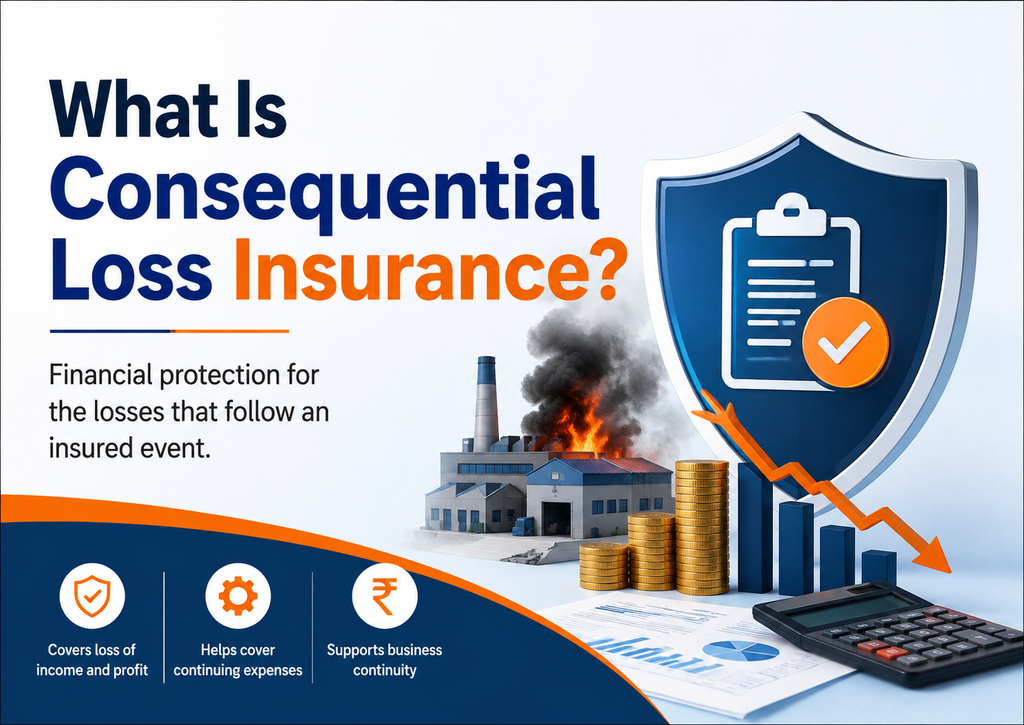
Consequential Loss Insurance is a type of insurance coverage designed to protect a business against financial losses that occur as a result of an insured event disrupting its normal operations.
Unlike insurance that primarily covers physical damage to property, Consequential Loss Insurance focuses on the financial impact that follows the damage. It is commonly associated with businesses that may suffer loss of income when their operations are interrupted because of events such as fire or other insured perils.
Understanding Consequential Loss
A business can experience two different types of losses after an unexpected event.
The first is physical loss or damage, such as damage to a building, machinery, equipment, stock, or other business property.
The second is the financial loss that may arise because the business cannot operate normally. This may include lost profit, continuing expenses, or additional costs incurred to reduce the interruption.
Consequential Loss Insurance is intended to address this second category of loss, subject to the terms, conditions, limits, and exclusions of the policy.
Why Is Consequential Loss Insurance Important?
Physical property damage can sometimes be repaired relatively quickly, but the financial consequences may continue for a much longer period.
For example, if a manufacturing unit suffers major fire damage, the property may be insured under a fire or property policy. However, the business may also lose income while machinery is being repaired, production remains suspended, or customers cannot be served.
Consequential Loss Insurance can provide financial protection against eligible losses arising from such business interruption.
What Can Consequential Loss Insurance Cover?
The exact coverage depends on the policy wording, but it may generally relate to financial consequences such as:
- Loss of business income or profit
- Continuing fixed expenses
- Certain operating expenses that continue during interruption
- Additional expenses incurred to reduce the impact of interruption
- Other eligible financial losses specifically covered under the policy
The calculation of the loss is generally based on the financial information of the business and the provisions of the policy.
Relationship Between Property Damage and Consequential Loss
Consequential Loss Insurance is often closely connected with an underlying property insurance policy.
For instance, a fire may damage a factory’s machinery. Property insurance may respond to the physical damage, while Consequential Loss Insurance may address the resulting financial interruption, provided the relevant policy conditions are satisfied.
This distinction is important because property damage and consequential financial loss are not necessarily covered in the same way.
What Is Business Interruption?
Business interruption refers to a situation where a business is unable to operate normally, or its operations are significantly affected, because of an insured event.
The interruption may result in reduced production, lower sales, loss of customers, or increased operating costs.
Consequential Loss Insurance is intended to provide financial protection against specified losses arising from such interruption rather than simply paying for the physical repair of damaged property.
How Is a Consequential Loss Claim Generally Valued?
The financial loss is usually assessed using business records and the policy’s method of calculation.
Factors that may be relevant include:
- Previous business performance
- Expected turnover
- Gross profit or other applicable financial measures
- Period of interruption
- Trends in the business
- Continuing expenses
- Additional expenses
- Policy limits and applicable deductibles
Because every business has different financial circumstances, the calculation can be more complex than determining the cost of repairing physical property.
Important Policy Conditions
Consequential Loss Insurance generally contains specific conditions relating to the insured event, period of indemnity, calculation of loss, policy limits, exclusions, and documentation.
The policy wording determines whether a particular financial loss is covered. A business should therefore not assume that every loss resulting from an interruption will automatically be payable.
Common Exclusions and Limitations
Policies may contain exclusions or limitations for certain types of losses. These can vary depending on the insurer and policy.
Examples may include losses arising from events that are not insured, certain indirect circumstances, inadequate insurance, policy exclusions, or losses outside the specified period of indemnity.
Understanding these provisions is important when evaluating the extent of financial protection available under a policy.
Consequential Loss Insurance vs Property Insurance
Property Insurance primarily protects against physical damage to insured property.
Consequential Loss Insurance focuses on the financial consequences of an insured interruption.
For example:
Property Insurance: Covers eligible physical damage to a factory caused by an insured event.
Consequential Loss Insurance: May cover eligible loss of income or profit resulting from the interruption caused by that insured event.
The two forms of protection can therefore complement each other.
Why Claims Can Become Complex
Consequential Loss claims can involve detailed financial calculations and interpretation of policy conditions.
Disagreements may arise over the amount of business income lost, the period of interruption, the cause of the loss, the applicable policy limits, or whether particular expenses should be included in the calculation.
For this reason, consequential loss claims can require careful examination of both policy terms and financial records.
Final Understanding
Consequential Loss Insurance is essentially designed to protect a business from the financial impact of an insured interruption, rather than only the cost of repairing physical damage.
It can be particularly relevant to businesses where an interruption could result in substantial loss of income or continuing expenses. However, the actual protection depends on the specific policy wording, insured event, limits, exclusions, and method used to calculate the loss.
Understanding the difference between physical property damage and the financial consequences of business interruption is essential when evaluating Consequential Loss Insurance.
Phone: +91 99103-52249
Email: help@insuranceresolve.com
Website: www.insuranceresolve.com

