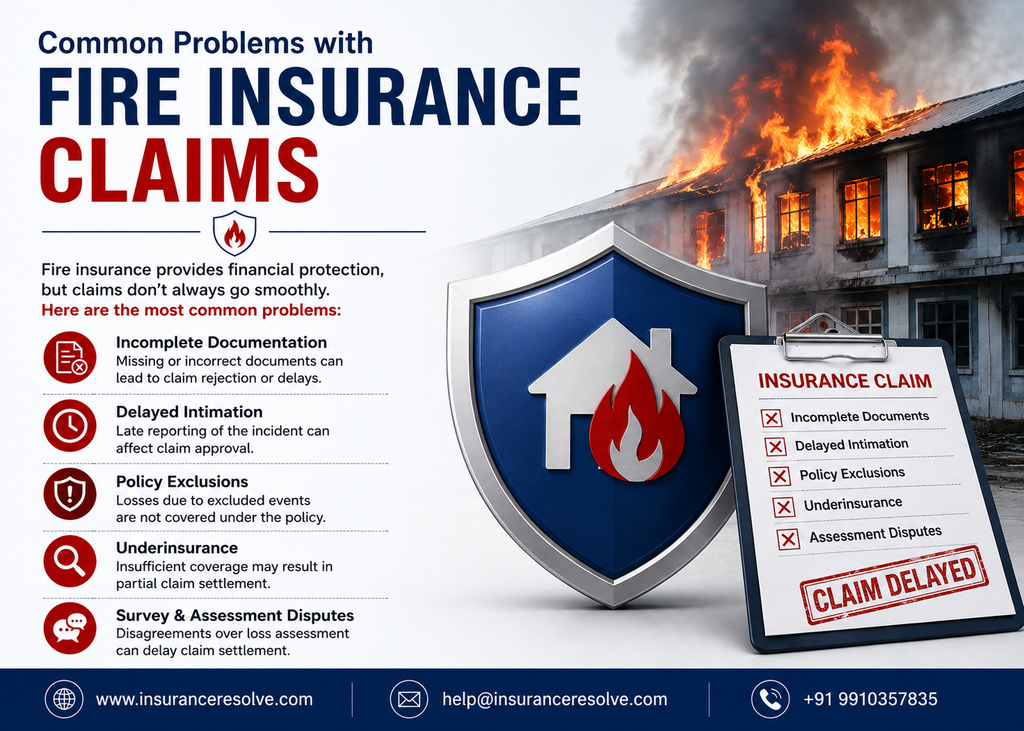

A fire insurance claim is made when insured property, stock, equipment, or other assets are damaged or destroyed by a covered fire-related event. Although fire insurance can provide important financial protection, claim disputes and delays can arise for several reasons.
Understanding these common problems can help policyholders better understand why a fire insurance claim may not be settled exactly as expected.
Claim Amount Disputes
One of the most common problems is a difference between the amount claimed by the policyholder and the amount assessed by the insurer.
The policyholder may calculate the loss based on the cost of replacing damaged property, while the insurer may apply policy provisions relating to depreciation, valuation, salvage, deductibles, or other conditions.
As a result, the final settlement may be lower than the amount originally claimed.
Disputes Over the Cause of Fire
The cause of the fire can become an important issue during claim assessment.
The insurer may investigate whether the fire resulted from an insured peril or whether circumstances exist that fall under a policy exclusion.
Questions regarding electrical faults, negligence, arson, machinery failure, short circuits, or other possible causes can sometimes lead to detailed investigation and delays.
Policy Exclusions
Fire insurance policies do not necessarily cover every type of loss connected with a fire.
Policies contain exclusions that may remove certain circumstances, property, or types of damage from coverage.
A dispute can arise when the policyholder believes the loss is covered but the insurer relies on an exclusion to limit or deny the claim.
Underinsurance
Underinsurance can become a significant issue when the insured value of the property is lower than its actual value.
For example, if a commercial property and its contents are worth substantially more than the amount for which they are insured, the policy may contain provisions that affect the claim calculation.
This can result in a settlement that is lower than the policyholder expected.
Disputes Over Stock and Inventory
For businesses, fire can damage or destroy large quantities of stock.
Determining the actual value of damaged or destroyed inventory can sometimes be difficult. Issues may arise regarding purchase records, stock registers, invoices, sales records, damaged goods, salvage value, or the quantity of stock present at the time of the incident.
These valuation differences can affect the final claim settlement.
Documentation Issues
Fire claims can involve significant amounts of property and financial loss. Insurers may require documents to assess the claim and establish the extent and value of the loss.
Problems may arise when records are incomplete, inconsistent, unavailable, or difficult to verify.
For businesses, documents such as invoices, accounting records, inventory information, asset records, and other evidence can become particularly important in establishing the value of the loss.
Delay in Claim Settlement
Fire claims can sometimes take time to resolve because the loss may be extensive and require investigation, assessment, verification, or valuation.
Delays may become more complicated when there are disagreements over the cause of the fire, the amount of loss, policy coverage, or supporting documentation.
A prolonged delay can create additional financial pressure, particularly for businesses that depend on the damaged premises or equipment for daily operations.
Depreciation and Valuation Disputes
The method used to calculate the value of damaged property can affect the settlement amount.
Depending on the policy, depreciation may be applied to certain assets. There may also be differences between replacement cost, market value, reinstatement value, or another valuation basis specified in the policy.
These differences can result in disagreements between the insurer and policyholder.
Salvage Value Disputes
After a fire, some damaged property may still have residual or salvage value.
The insurer may consider the value of recoverable materials, damaged stock, machinery, or other assets when calculating the final settlement.
Disagreements over the amount of salvage value can therefore affect the claim amount.
Business Interruption Losses
A fire can cause more than physical property damage. A business may also experience lost income or additional expenses because operations are interrupted.
Where business interruption coverage applies, calculating the financial impact can be complicated.
Disputes may arise over the period of interruption, expected revenue, saved expenses, increased operating costs, or other factors used to calculate the covered loss.
Claim Rejection
In some cases, a fire insurance claim may be rejected rather than partially settled.
Possible reasons can include an applicable exclusion, policy condition, insufficient evidence, questions regarding the cause of the loss, non-disclosure, or other circumstances identified by the insurer.
Whether a rejection is justified depends on the specific policy wording and facts of the incident.
Conclusion
Fire insurance claims can involve several potential problems, including claim amount disputes, questions about the cause of the fire, exclusions, underinsurance, documentation issues, valuation differences, delays, and disagreements over business interruption losses.
The final outcome of a fire insurance claim depends on the policy wording, insured value, nature and extent of the loss, available evidence, applicable exclusions, and the insurer’s assessment.
Understanding these common issues can help policyholders better understand why a fire insurance claim may be delayed, reduced, disputed, or rejected.