
Underinsurance in motor insurance occurs when the insured value of a vehicle is lower than its actual value or the amount required to adequately cover the vehicle. In simple terms, the vehicle is insured for less than it is worth.
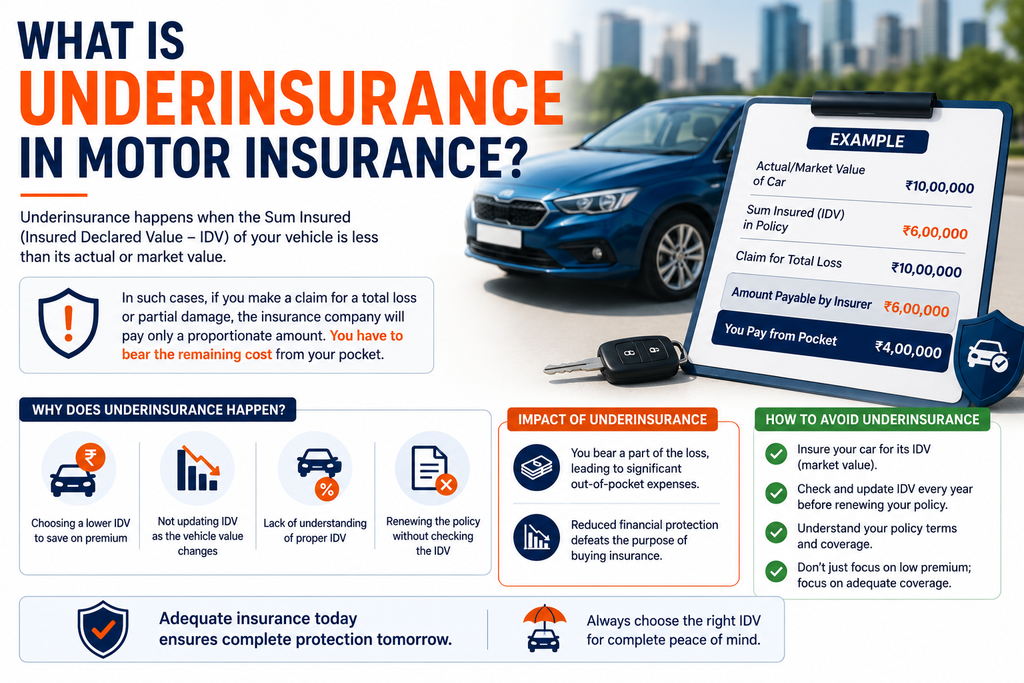
Underinsurance can affect the amount a policyholder receives when making a claim, depending on the policy terms and the way the insurer calculates the loss.
How Does Underinsurance Occur?
Underinsurance can happen for several reasons:
- Choosing an Insured Declared Value (IDV) that is too low
- Failing to update the vehicle’s value over time
- Selecting a policy primarily based on a lower premium
- Incorrectly estimating the vehicle’s value
- Not understanding how the insurer determines the IDV
What Is IDV in Motor Insurance?
Insured Declared Value (IDV) is generally the maximum amount payable under a motor insurance policy for the vehicle in cases such as total loss or theft, subject to the policy terms.
The IDV generally considers factors such as the vehicle’s age, depreciation, make, model, and other relevant details.
For example, if a vehicle has an actual market-related value of ₹8 lakh but the policy’s IDV is set significantly lower, the policyholder may not receive an amount equivalent to the vehicle’s full value in a total-loss situation.
Why Is Underinsurance a Problem?
Underinsurance can result in insufficient financial protection.
If a vehicle is insured for less than its appropriate value, the policyholder may have to bear part of the financial loss personally. This can be particularly important when dealing with expensive vehicles or major repairs.
Underinsurance and Partial Claims
The effect of underinsurance on a partial-loss claim depends on the policy wording.
Some policies may contain an underinsurance or average clause, under which the insurer may proportionately reduce the amount payable when the property is insured for less than its applicable value.
For motor insurance, however, the treatment can vary depending on the type of policy, coverage, claim, and applicable policy conditions. Therefore, policyholders should not assume that every motor claim will automatically be reduced because of underinsurance.
How Can You Avoid Underinsurance?
To reduce the risk of inadequate motor insurance coverage:
- Check the IDV when purchasing or renewing your policy.
- Do not select an unusually low IDV simply to reduce the premium.
- Compare the IDV offered by different insurers.
- Review your policy documents carefully.
- Consider the vehicle’s age, condition, and applicable depreciation.
- Understand the difference between IDV and the vehicle’s actual market value.
- Ask the insurer or insurance professional to explain how the IDV has been calculated.
Underinsurance vs. Overinsurance
Underinsurance means the vehicle is insured for less than its applicable value.
Overinsurance means the insured amount is higher than the vehicle’s applicable value. However, having a higher IDV does not necessarily mean that a policyholder will receive that amount for every type of claim. Claim payments remain subject to the policy terms and the nature of the loss.
Conclusion
Underinsurance in motor insurance can leave a policyholder with less financial protection than expected, particularly in cases involving theft or total loss. Understanding IDV and reviewing the insured value at each renewal can help ensure that your motor insurance remains appropriate.
Always review the policy wording, IDV, exclusions, deductibles, and coverage conditions before renewing your motor insurance.
Contact Insurance Resolve
For assistance with motor insurance, policy reviews, claim-related concerns, or insurance disputes:
📞 Call: 99103-52249
📧 Email: help@insuranceresolve.com

