

FD Converted into Insurance Policy Without Consent: What Customers Should Know
A Fixed Deposit (FD) is commonly used by customers who want to save money for a specific period and earn interest on their deposit. However, some customers may later discover that the money they believed was invested in an FD was used to purchase an insurance policy.
When this happens without clear explanation or informed consent, it can lead to confusion, financial concerns, and disputes between the customer, bank, insurance company, or intermediary.
Understanding the difference between an FD and an insurance policy is important for every customer.
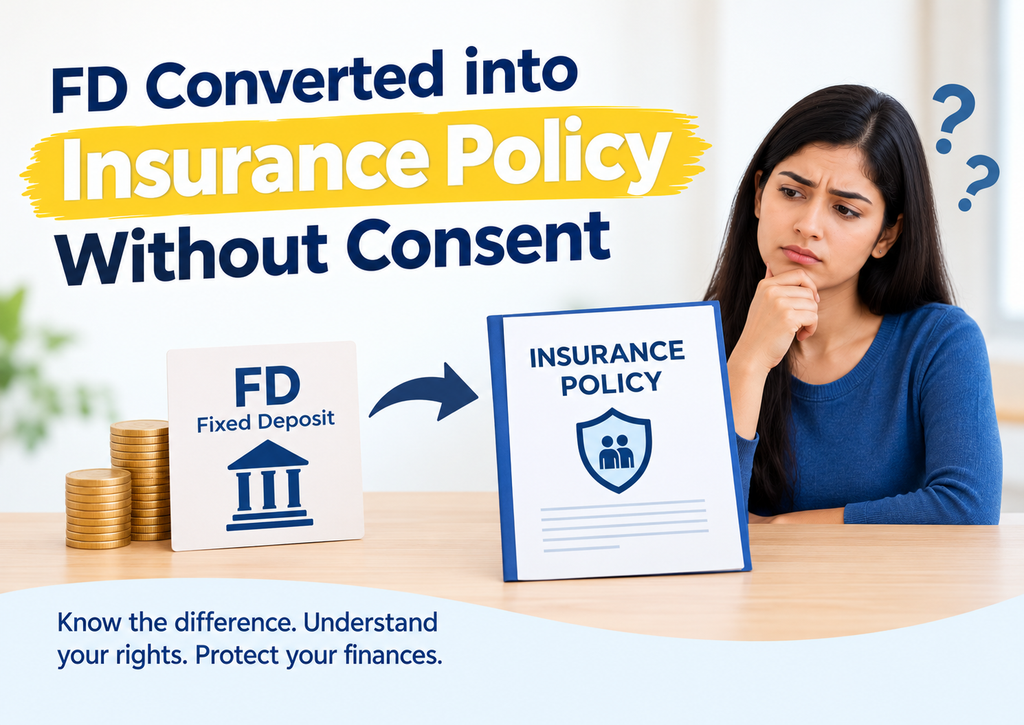
What Does FD Conversion into an Insurance Policy Mean?
FD conversion into an insurance policy refers to a situation where a customer approaches a bank or financial representative with the intention of opening a fixed deposit, but the funds are instead used to purchase an insurance product.
The customer may have believed that the money was being placed in:
- A fixed deposit
- A bank savings scheme
- A guaranteed-return investment
- A short-term deposit product
- A secure financial product offered by the bank
However, the actual transaction may involve a life insurance policy, endowment plan, money-back policy, ULIP, or another insurance product.
The concern arises when the customer was not clearly informed that the transaction involved insurance or did not knowingly agree to purchase the policy.
FD and Insurance Policies Are Different
A fixed deposit and an insurance policy are different financial products with different purposes and conditions.
An FD is primarily a savings product where the customer deposits a specific amount for a chosen period at an applicable interest rate. An insurance policy may provide life coverage, savings benefits, investment opportunities, or a combination of these features.
| Feature | Fixed Deposit | Insurance Policy |
|---|---|---|
| Primary purpose | Savings and interest income | Insurance protection, savings, or investment |
| Payment | Usually a one-time deposit | May require regular or one-time premiums |
| Tenure | Usually selected by the depositor | Often involves a longer policy term |
| Returns | Based on the applicable FD interest rate | Based on policy terms, bonuses, charges, or market performance |
| Withdrawal | Premature withdrawal may be allowed under conditions | Surrender or withdrawal may have restrictions and deductions |
| Documentation | FD receipt or deposit advice | Policy document, proposal form, and benefit illustration |
| Financial commitment | Usually limited to the deposit amount | May include future premium obligations |
Because these products are different, a customer’s expectations may not match the actual policy benefits or financial commitments.
How Customers May Become Confused
Customers may face confusion when insurance products are sold through banks or financial institutions. Some common situations include:
Product Misrepresentation
An insurance policy may be described as a deposit, investment, or guaranteed-return product without clearly explaining its insurance nature.
Incomplete Explanation
The representative may not properly explain the policy term, premium payment period, surrender value, exclusions, charges, or maturity conditions.
Use of Technical Language
Insurance documents often contain technical terms that may not be easy for every customer to understand. Customers may sign documents without fully understanding the product they are purchasing.
Trust in Bank Representatives
Customers may assume that a product recommended by a bank employee or relationship manager is an FD or a bank deposit, even when it is an insurance product issued by a separate insurer.
Digital Consent
Some policies may be processed through digital forms, OTPs, electronic signatures, or online applications. A customer may later claim that the digital consent did not reflect their actual understanding of the product.
What Is Informed Consent?
Informed consent means that a customer understands the essential details of a product before agreeing to purchase it.
For an insurance policy, informed consent generally involves awareness of:
- The name and type of the product
- The name of the insurance company
- The premium amount
- The policy term
- The premium payment term
- The sum assured
- Guaranteed and non-guaranteed benefits
- Maturity benefits
- Surrender conditions
- Applicable charges
- Exclusions and limitations
- Consequences of stopping premium payments
A signature or digital confirmation may appear in transaction records, but a dispute may still arise if the customer claims that the product was not properly explained or was presented as something else.
Possible Signs That an FD Was Not Actually Created
A customer may notice certain differences after reviewing the documents or account statement. Possible signs include:
- Receiving an insurance policy document instead of an FD receipt
- Seeing a premium debit rather than an FD deposit entry
- Finding terms such as “policyholder,” “life assured,” “sum assured,” or “premium”
- Seeing a long policy term instead of a fixed deposit maturity period
- Finding surrender value conditions
- Being required to pay future premiums
- Receiving a benefit illustration instead of an FD interest calculation
- Discovering exclusions or insurance-related conditions
- Finding that the promised maturity amount is not stated as an FD maturity value
These signs do not automatically establish wrongdoing, but they may indicate that the product needs closer review.
Financial Consequences for Customers
When money intended for an FD is used to purchase an insurance policy, the customer may experience financial consequences.
Long-Term Lock-In
Many insurance products have policy terms extending over several years. This may not match the customer’s original intention to keep money in a short- or medium-term FD.
Reduced Value on Early Exit
Surrendering an insurance policy before the end of its term may result in a lower payout than the amount paid, depending on the policy conditions.
Future Premium Liability
Some insurance policies require regular premium payments. Customers who expected a one-time FD deposit may not have planned for these future payments.
Different Return Expectations
FD returns are generally based on a stated interest rate, whereas insurance policy benefits may depend on guaranteed benefits, bonuses, charges, market performance, or other conditions.
Limited Liquidity
An insurance policy may not provide the same access to funds that a customer expected from a fixed deposit.
Mismatch with Financial Goals
A customer may have intended to use FD maturity proceeds for education, medical expenses, retirement, business needs, or another planned requirement. A long-term insurance policy may not meet that objective.
FD Conversion and Insurance Mis-selling
An FD allegedly converted into an insurance policy without proper consent may raise concerns about insurance mis-selling.
Insurance mis-selling may involve:
- Presenting one product as another
- Making inaccurate statements about returns
- Hiding important policy conditions
- Failing to explain charges or lock-in periods
- Recommending an unsuitable product
- Promising benefits that are not included in the policy
- Providing incomplete or misleading information
- Processing a policy without proper customer understanding
However, every case depends on its specific facts. A customer may have signed a proposal form, but the main question may still be whether the customer understood the nature and terms of the product before consenting.
Important Documents Related to Such Disputes
The documents connected with the transaction may help explain what the customer requested and what was actually processed. These may include:
- Bank account statements
- FD application forms
- FD receipts or deposit advice
- Insurance proposal forms
- Insurance policy documents
- Benefit illustrations
- Premium receipts
- Debit transaction records
- Emails and SMS messages
- WhatsApp communication
- Product brochures
- Recorded communications, where available
- Consent forms
- Policy welcome letters
- Bank or insurer correspondence
The documents may help distinguish between an actual FD transaction, an insurance purchase, a misunderstanding, or a possible mis-selling concern.
Free-Look Period in Insurance Policies
Many life insurance policies provide a free-look period during which the policyholder may review the policy and request cancellation, subject to applicable rules and policy conditions.
The duration of the free-look period and any permitted deductions may depend on the product, policy terms, and applicable regulations. A free-look cancellation is different from surrendering a policy after the free-look period has ended.
Customers should carefully read the policy document to understand the applicable cancellation provisions and financial implications.
Role of Banks and Insurance Companies
When an insurance policy is sold through a bank, different entities may be involved. The bank may act as a corporate agent or distribution partner, while the insurance company issues the policy and manages the insurance contract.
The responsibilities and records of the bank, insurer, agent, or intermediary may differ depending on the transaction.
Important questions in such cases may relate to:
- Who received the customer’s request?
- Who explained the product?
- Which entity processed the payment?
- Which company issued the policy?
- Was the customer given the policy document?
- Were the policy terms explained?
- Was the product represented accurately?
- Was consent obtained for the actual product purchased?
Why Clear Product Disclosure Matters
Clear product disclosure helps customers understand whether they are purchasing a deposit, insurance policy, investment product, or another financial service.
Customers should be able to understand:
- What product they are buying
- What benefits are guaranteed
- What benefits are conditional or non-guaranteed
- How long the product will continue
- Whether future payments are required
- What happens if payments stop
- Whether early exit is possible
- What charges or deductions may apply
- What amount may be payable at maturity or surrender
Without clear disclosure, customers may make financial decisions based on assumptions that do not match the actual product terms.
Conclusion
An FD converted into an insurance policy without clear and informed consent can create significant confusion and financial concerns. A fixed deposit and an insurance policy have different purposes, returns, liquidity conditions, documentation, and long-term obligations.
Customers who believe they requested an FD but received an insurance policy should understand the distinction between the two products and carefully review the transaction and policy documents. The issue may involve product confusion, inadequate disclosure, mis-selling, incorrect processing, or an alleged unauthorized transaction, depending on the facts.
Transparent communication, accurate product representation, and informed consent are essential when insurance products are sold through banks and financial institutions.
Contact Insurance Resolve – FD Converted into Insurance Policy Without Consent
For assistance with insurance mis-selling concerns, policy disputes, unauthorized policy conversion, policy reviews, and other insurance-related matters:
📞 Call: 99103-52249
📧 Email: help@insuranceresolve.com
🌐 Website: www.insuranceresolve.com

