
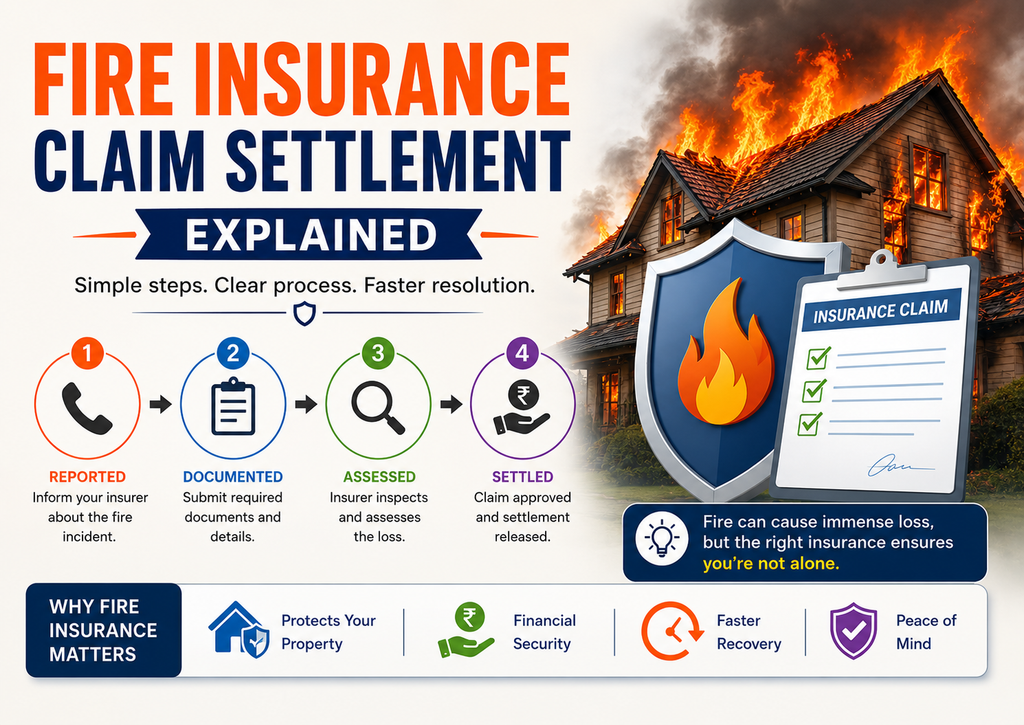
A fire insurance claim settlement refers to the process through which an insurer assesses a covered fire-related loss and determines the amount payable under the terms of the insurance policy.
When a fire damages a building, machinery, stock, furniture, equipment, or other insured property, the final claim amount depends on several factors, including the extent of damage, policy coverage, sum insured, exclusions, valuation basis, and applicable policy conditions.
What Is Fire Insurance Claim Settlement?
Fire insurance claim settlement is the financial outcome of an eligible claim after the insurer evaluates the reported loss.
The settlement amount may not always be the same as the total loss suffered by the policyholder because insurance coverage is limited by the policy terms, conditions, exclusions, deductibles, and applicable limits.
How Is a Fire Insurance Claim Assessed?
The assessment of a fire insurance claim can involve examining:
- Cause of the fire
- Extent of physical damage
- Property and assets affected
- Sum insured
- Value of the damaged property
- Policy exclusions
- Deductibles or excess
- Underinsurance
- Salvage value
- Applicable policy conditions
For larger or more complex losses, a surveyor or loss assessor may be involved in evaluating the damage and estimating the financial loss.
What Factors Affect Fire Insurance Claim Settlement?
1. Policy Coverage
The first consideration is whether the fire or resulting damage falls within the coverage provided by the policy.
If a particular loss is excluded, that portion may not be payable.
2. Sum Insured
The sum insured represents the maximum amount of insurance available for the insured property or interest, subject to the policy terms.
If the actual value of the property is significantly higher than the sum insured, the policyholder may have insufficient coverage.
3. Underinsurance
Underinsurance can affect the amount payable when the property is insured for less than its applicable value.
Where an average clause applies, the claim settlement may be proportionately reduced according to the policy terms.
4. Nature and Extent of Damage
The insurer may assess whether the property is partially damaged or completely destroyed.
The extent and type of damage can influence the calculation of the claim amount.
5. Valuation Basis
The method used to determine the value of damaged property can depend on the policy.
For example, some policies may use a reinstatement value basis, while other situations may involve market value or another specified valuation method.
6. Deductibles and Excess
A policy may require the policyholder to bear a specified portion of the loss. This amount can be deducted from the otherwise payable claim amount.
7. Salvage Value
After a fire, some damaged property may retain a recoverable value. This remaining value, known as salvage, can be considered during claim assessment depending on the circumstances and policy terms.
Fire Insurance Claim Settlement and Reinstatement Value
Under a reinstatement value basis, the valuation generally focuses on the cost of restoring or replacing the damaged property with similar property, subject to the policy’s conditions.
This is different from simply calculating the depreciated value of an old asset.
The actual settlement depends on the specific valuation provisions contained in the policy.
Fire Insurance Claim Settlement and Stock
For businesses, fire can cause substantial damage to stock and inventory.
The assessment of stock losses may involve examining purchase records, stock registers, invoices, sales records, accounting information, and other evidence relevant to determining the quantity and value of the damaged goods.
Why Can the Final Settlement Be Lower Than the Claimed Amount?
The amount claimed by a policyholder and the amount ultimately assessed by the insurer may differ.
This can happen because of:
- Policy exclusions
- Underinsurance
- Deductibles
- Depreciation where applicable
- Valuation differences
- Salvage
- Uninsured property
- Policy limits
- Disputed portions of the loss
Therefore, the claim amount requested and the claim amount payable under the policy are not necessarily the same.
Fire Insurance Claim Short Settlement
A short-settled fire insurance claim occurs when the insurer pays an amount that the policyholder believes is lower than the amount actually payable under the policy.
Such differences may arise from disagreements regarding valuation, damage assessment, policy interpretation, underinsurance, or other factors.
Understanding the basis of the settlement is important when there is a significant difference between the claimed amount and the amount offered.
Fire Insurance Claim Rejection vs Settlement
A rejected fire insurance claim means the insurer has declined the claim based on stated grounds.
A settled claim, on the other hand, means the insurer has determined an amount payable under the policy.
A claim can also be partially settled, where the insurer accepts some portions of the loss but does not accept the entire amount claimed.
Why Understanding the Policy Matters
Fire insurance policies can contain detailed provisions relating to coverage, exclusions, valuation, reinstatement, underinsurance, deductibles, and other conditions.
Therefore, understanding the policy wording is important when interpreting how a fire insurance claim has been assessed and settled.
Fire Insurance Claim Issues
Policyholders and businesses may face various problems involving fire insurance claims, including:
- Claim delays
- Claim rejection
- Short settlement
- Valuation disputes
- Underinsurance disputes
- Coverage disagreements
- Documentation-related issues
The reason for an insurance dispute can vary depending on the circumstances of the loss and the applicable policy terms.
Get Help With Fire Insurance Claim Issues
If you are facing a fire insurance claim rejection, delay, short settlement, or other insurance-related problem, Insurance Resolve provides professional guidance for policyholders and businesses dealing with insurance claim and complaint-related concerns.
Insurance Resolve – Insurance Claim & Complaint Solutions
📞 Phone: +91 99103-52249
📧 Email: help@insuranceresolve.com
🌐 Website: www.insuranceresolve.com

