

Cyber insurance can help businesses manage financial losses arising from cyberattacks, data breaches, ransomware, and other covered cyber incidents. However, a cyber insurance claim may be rejected when the incident or circumstances do not meet the requirements of the policy.
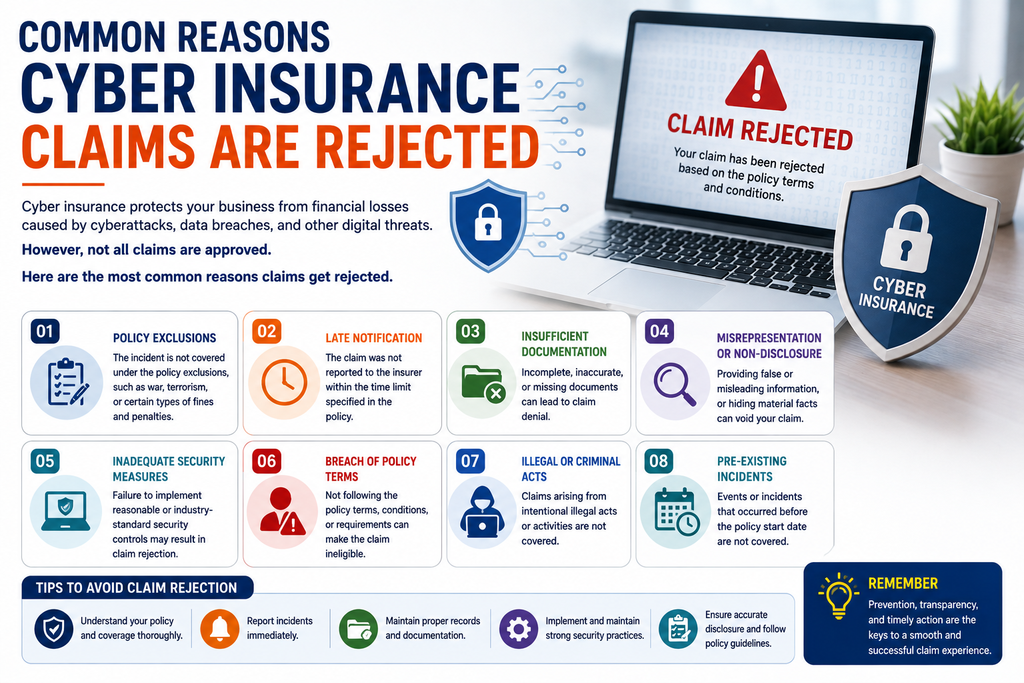
Understanding the common reasons for cyber insurance claim rejection can help businesses maintain appropriate coverage and follow policy requirements.
The Incident Is Excluded
A cyber insurance policy may contain specific exclusions for certain types of losses, attacks, or circumstances.
If the incident falls within an exclusion, the insurer may reject the claim.
Failure to Follow Cybersecurity Requirements
Some cyber insurance policies require businesses to maintain specific security measures, such as:
- Multi-factor authentication
- Regular data backups
- Access controls
- Antivirus or endpoint protection
- Security updates and patches
Failure to comply with applicable policy requirements may affect coverage.
Late Notification of the Incident
Cyber incidents often require immediate action. Policies may require the insured to notify the insurer as soon as an incident is discovered.
Delaying notification can make investigation and mitigation more difficult and may affect the claim.
Inadequate Documentation
Insurers may require evidence to establish what happened and the extent of the loss.
Important documents can include incident reports, forensic reports, financial records, invoices, communication records, and other evidence related to the cyber event.
Misrepresentation During Policy Application
Providing inaccurate or incomplete information about a company’s cybersecurity systems, previous incidents, business activities, or risk exposure can create problems when a claim is made.
Businesses should ensure that information provided during underwriting is accurate and complete.
Lack of Required Security Controls
If a policy requires certain cybersecurity controls and the business does not have them in place, the insurer may question whether the claim meets the policy conditions.
Businesses should understand their cybersecurity obligations before purchasing the policy.
Pre-Existing or Previously Known Incidents
A cyber insurance policy may not cover an incident that was already known, discovered, or reasonably suspected before the policy began, depending on the policy wording.
Unauthorised or Intentional Acts
Losses resulting from intentional wrongdoing, fraud, or certain acts by employees or other individuals may be excluded or subject to specific conditions.
Losses Outside the Policy Coverage
Cyber policies can cover different categories of loss, such as data recovery, business interruption, cyber extortion, notification costs, or third-party liability.
A claim may be rejected if the particular loss is not included in the policy.
Failure to Mitigate the Loss
After discovering a cyber incident, businesses are generally expected to take reasonable steps to contain the incident and reduce further damage.
Failure to take appropriate action may affect the assessment of the claim, depending on the policy terms.
How to Reduce Cyber Insurance Claim Problems
Businesses can reduce the risk of claim disputes by:
- Reviewing the policy exclusions carefully.
- Maintaining required cybersecurity controls.
- Keeping accurate security records.
- Reporting incidents promptly.
- Maintaining reliable backups.
- Conducting regular security assessments.
- Providing accurate information during policy application and renewal.
- Following the insurer’s incident-response and notification requirements.
Conclusion
Cyber insurance claims can be rejected or disputed because of policy exclusions, inadequate security controls, late notification, incomplete documentation, inaccurate information, or losses that fall outside the coverage.
Businesses should regularly review their cyber insurance policy and cybersecurity practices to ensure that the two remain aligned.
Contact Insurance Resolve
For assistance with cyber insurance policies, claim rejections, policy reviews, and insurance-related concerns:
📞 Call: 99103-52249
📧 Email: help@insuranceresolve.com

