
Introduction
Insurance is an important part of financial planning, but choosing a suitable policy involves more than comparing premiums or selecting a well-known insurance company. A policy that works well for one person may not provide the right protection for another.
Every individual, family, and business has different financial responsibilities, risks, and protection requirements. The right insurance policy should match these needs, provide appropriate coverage, and have terms that the policyholder clearly understands.
Understanding what makes an insurance policy suitable can help people make informed decisions and reduce the possibility of confusion or disputes when making a claim.
Understanding Your Insurance Needs
The first consideration when selecting insurance is understanding the risk you want to protect yourself against. Different insurance products are designed to address different types of financial risks.
Life insurance may help protect the financial future of dependants, while health insurance can cover eligible medical expenses. Motor insurance provides protection against specified vehicle-related risks and liabilities, while home and commercial insurance can help protect property and business interests against covered losses.
A suitable policy should address the particular risks relevant to your circumstances rather than simply offering a long list of benefits that may not be useful to you.
Coverage That Matches Your Requirements
The amount and type of coverage are among the most important factors in choosing an insurance policy. A policy with a low premium may appear attractive, but limited coverage could leave you facing substantial expenses when an unexpected event occurs.
For example, a health insurance policy should be evaluated in relation to potential medical costs, the needs of the people covered, and the applicable limits. Similarly, motor insurance should be assessed according to the protection required for third-party liabilities and damage to the insured vehicle.
The suitability of coverage also depends on the exclusions, restrictions, deductibles, and other conditions stated in the policy.
Premium Affordability and Long-Term Commitments
Insurance premiums should fit within your financial circumstances. Choosing a policy with premiums that are difficult to maintain may create problems later, particularly when regular payments are required to keep the coverage active.
However, affordability should not be judged by premium cost alone. A lower premium may come with higher deductibles, narrower coverage, or other limitations. A more expensive policy does not automatically provide better protection either.
The important consideration is whether the premium is reasonable in relation to the coverage, benefits, exclusions, and financial commitment involved.
Understanding Policy Terms and Conditions
Insurance policies contain specific terms that determine the circumstances under which benefits are payable. These terms may include eligibility requirements, waiting periods, exclusions, claim documentation, coverage limits, renewal conditions, and cancellation provisions.
A policyholder who understands these conditions is better positioned to evaluate whether the product meets their expectations.
For health insurance, particular attention may be needed for pre-existing medical conditions, waiting periods, co-payments, room-rent limits, and exclusions. For motor or property insurance, the insured value, covered events, deductibles, and loss assessment conditions may be particularly important.
Reading the policy document and Customer Information Sheet can help clarify the essential features of the coverage.
The Importance of Honest and Accurate Information
Insurance suitability also depends on the accuracy of the information provided when applying for a policy. Details such as age, medical history, occupation, income, vehicle usage, or property information may be relevant, depending on the insurance product.
Incomplete or inaccurate disclosures can lead to disagreements during underwriting or claim assessment and may affect the outcome in accordance with the policy terms and applicable rules.
Policyholders should ensure that the information provided in the application is accurate and that they understand the declarations being made. Any uncertainty about a question or requirement should be clarified before the proposal is submitted.
Claim Conditions and Settlement Process
An insurance policy is intended to provide protection when a covered event occurs. Therefore, understanding the claim process is an important part of assessing its suitability.
Policyholders should understand how to notify the insurer, what documents may be required, how claims are assessed, and which conditions could affect the amount payable. It is also useful to understand whether the policy offers cashless facilities, reimbursement, repair arrangements, or another settlement method, depending on the product.
A policy’s suitability should be evaluated by looking at the actual contractual coverage and claim conditions rather than relying solely on promotional statements or verbal assurances.
Choosing Insurance for Your Stage of Life
Insurance needs may change over time. A young professional may have different financial responsibilities from a person supporting a family, managing a home loan, or operating a business.
Similarly, a growing family may need to reconsider its life and health insurance requirements, while a business owner may need protection for commercial property, equipment, liability, or business interruption.
Reviewing insurance needs periodically can help identify gaps in coverage or policies that no longer match current circumstances. Any changes should be considered carefully to avoid unintentionally losing valuable existing benefits.
Avoiding Misleading Insurance Promises
A policy may be unsuitable if it is purchased because of misleading claims, incomplete explanations, or promises that are not supported by the actual policy terms.
For example, a policyholder may believe that a product guarantees a particular return, covers every medical expense, or provides benefits that are not mentioned in the contract. Such misunderstandings can create serious disappointment when the policy is reviewed or a claim is submitted.
Important promises about coverage, returns, exclusions, and benefits should be verified against official policy documents. Policyholders should not feel pressured to purchase a product they do not understand.
When an Insurance Policy May Not Be Suitable
A policy may not meet your needs if its coverage is insufficient, its premiums are unaffordable, its exclusions are too restrictive for your requirements, or its benefits differ from what was represented at the time of purchase.
In some situations, a policyholder may discover that important features were not adequately explained or that the policy does not provide the expected protection.
Before making a decision to cancel or replace an existing policy, it is important to understand the consequences. A replacement policy may have different premiums, eligibility requirements, waiting periods, or exclusions. Cancelling an existing policy without evaluating these factors could create a gap in protection.
Conclusion
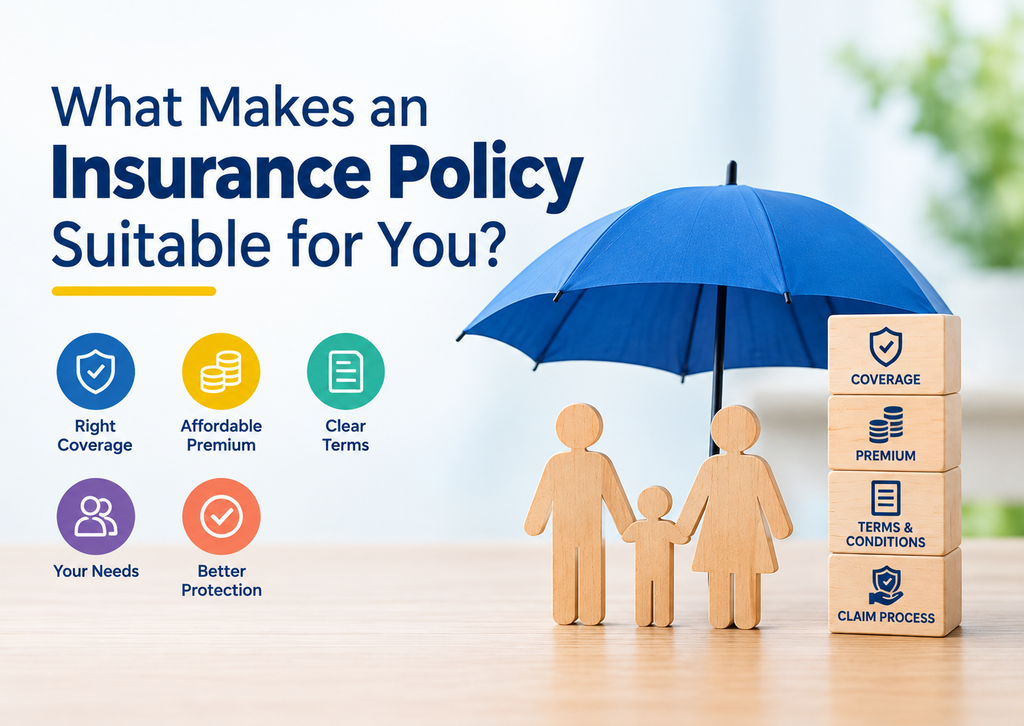
A suitable insurance policy is one that aligns with your protection needs, financial circumstances, and understanding of the policy conditions. Coverage, affordability, exclusions, claim requirements, and long-term commitments all play an important role in determining whether a policy is appropriate.
Taking the time to understand these factors can help policyholders make informed decisions and avoid misunderstandings about insurance benefits.
If you are experiencing problems related to insurance policy mis-selling, claim rejection, delayed claims, short settlement, lapsed policies, or other insurance service issues, Insurance Resolve can help you understand your concern and explore appropriate resolution options.
Insurance Resolve – We Resolve. You Relax.
Contact Insurance Resolve
- Website: https://insuranceresolve.com/
- Email: help@insuranceresolve.com
- WhatsApp / Contact No.: +91 9910352249

