

Introduction
Insurance policies contain several important terms that determine the protection available to policyholders. Two commonly used terms are sum assured and sum insured. Although they sound similar, they generally refer to different types of insurance benefits.
Understanding these terms is important when purchasing a policy, reviewing coverage, or dealing with an insurance claim. Confusing them may lead to incorrect expectations about the amount payable by an insurance company.
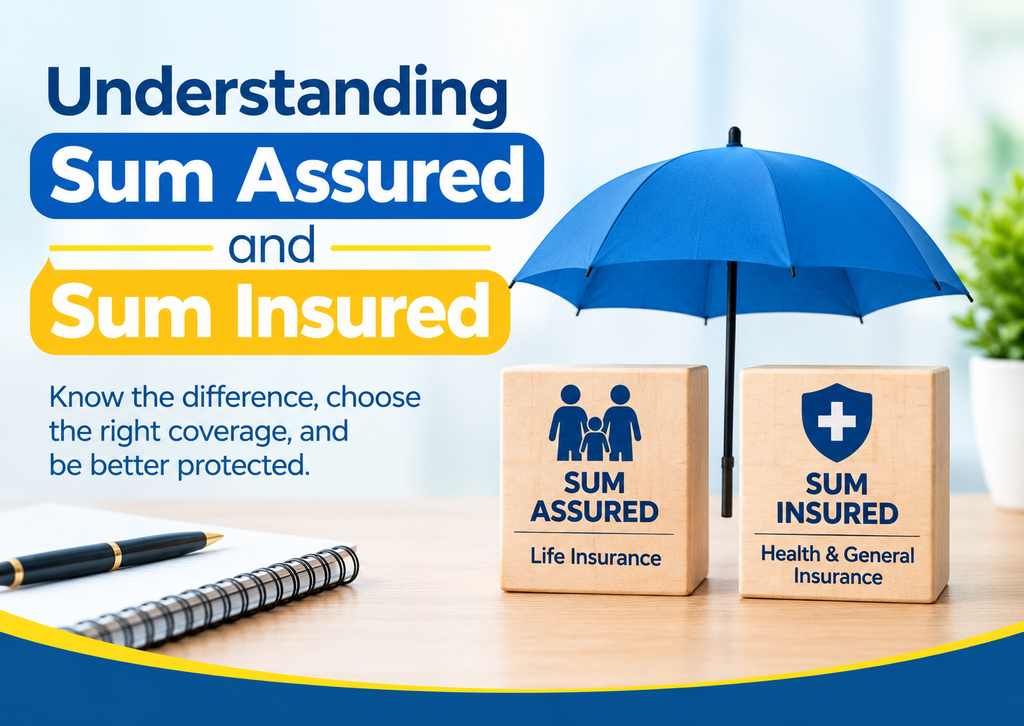
What Is Sum Assured?
Sum assured is a specified amount associated primarily with life insurance policies. It represents the basic insurance benefit promised under the policy, subject to its terms and conditions.
For example, suppose a person purchases a life insurance policy with a sum assured of ₹50 lakh. If the insured person dies during the covered period, the policy may provide a death benefit based on the sum assured, subject to the policy conditions and applicable provisions.
The actual amount payable may differ depending on the policy type, applicable riders, bonuses, exclusions, and other contractual terms.
In certain life insurance policies, the sum assured may also be relevant to maturity or other benefits. Therefore, policyholders should review the benefit illustration and policy document rather than assuming that every benefit will equal the basic sum assured.
What Is Sum Insured?
Sum insured is a term commonly used in health, motor, property, and other general insurance policies. It generally refers to the specified coverage amount or maximum limit of protection, subject to the policy terms.
For example, a health insurance policy with a sum insured of ₹10 lakh may cover eligible medical expenses up to the applicable limit, subject to exclusions, sub-limits, deductibles, co-payments, and other conditions.
Similarly, a property insurance policy may provide coverage based on the insured value of the property or its contents, as specified in the contract.
It is important to understand that the sum insured is not necessarily the amount paid for every claim. The payable amount depends on the actual covered loss, the terms of the policy, and the applicable limits.
Key Differences Between Sum Assured and Sum Insured
Type of insurance: Sum assured is commonly associated with life insurance, whereas sum insured is commonly associated with health and general insurance.
Purpose: Sum assured generally defines a specified life insurance benefit. Sum insured generally establishes a coverage amount or limit for covered losses or expenses.
Claim payment: A life insurance benefit may be determined by the sum assured and other applicable policy benefits. A general insurance claim is usually assessed according to the covered loss, policy limits, exclusions, and settlement conditions.
Relationship with actual loss: Life insurance benefits are generally not calculated by measuring the financial value of a person’s life. General insurance claims, particularly indemnity-based claims, are generally linked to the actual covered loss, subject to policy terms.
Examples: A life insurance policy may have a sum assured of ₹50 lakh, while a health insurance policy may have a sum insured of ₹10 lakh.
These are general distinctions. The precise meaning and operation of each term depend on the specific insurance product and its contractual wording.
Why Is Sum Assured Important in Life Insurance?
The sum assured is an important consideration when evaluating life insurance because it helps determine the level of financial protection intended for the policyholder’s dependants.
The appropriate amount may depend on the family’s living expenses, outstanding loans, children’s education costs, future financial commitments, and the income that would need to be replaced.
If the coverage is insufficient, the benefit may not adequately support the family’s financial needs. On the other hand, the suitability of a policy should also be evaluated in relation to affordability, policy duration, and the benefits actually provided.
Policyholders should review whether the stated sum assured represents the basic benefit or whether additional benefits are included separately.
Why Is Sum Insured Important in Health and General Insurance?
The sum insured helps establish the level of coverage available under a health or general insurance policy.
In health insurance, medical expenses can vary significantly depending on the treatment, hospital, location, and nature of the illness. A suitable sum insured should therefore be considered alongside the policy’s exclusions, room-rent limits, co-payments, waiting periods, and other restrictions.
In motor insurance, the insured declared value (IDV) is an important concept for own-damage coverage. It is not always interchangeable with the term sum insured. The applicable policy wording determines how the insured value and claim settlement are calculated.
For property insurance, the basis of valuation is also important. The insured amount should be understood in relation to the applicable valuation method and the coverage provided by the policy.
Does a Higher Sum Assured or Sum Insured Always Mean Better Protection?
Not necessarily. A higher coverage amount can provide greater financial protection, but the amount alone does not determine whether a policy is suitable.
A policy with a high sum insured may still contain exclusions, sub-limits, deductibles, or conditions that affect the amount payable. Similarly, a life insurance policy with a high sum assured may not meet a person’s needs if the policy duration or other benefits are unsuitable.
The quality and suitability of insurance depend on the coverage, premium, policy terms, exclusions, and the financial risks the policyholder wants to address.
Common Misunderstandings About Insurance Coverage
One common misunderstanding is that the sum insured will automatically be paid in full whenever a claim is made. In many general insurance policies, the insurer assesses the covered loss and applies the relevant policy conditions before determining the payable amount.
Another misunderstanding is that the sum assured always represents the total amount payable under every life insurance policy. Depending on the product, the actual benefit may include or be affected by other contractual provisions.
Policyholders may also confuse the premium with the insured amount. The premium is the amount paid for insurance coverage, while the sum assured or sum insured refers to a benefit amount or coverage limit.
Understanding these differences can help prevent confusion during policy selection and claim settlement.
What If Your Insurance Claim Is Settled for Less Than Expected?
A claim may be settled for less than the amount a policyholder expected because of policy limits, exclusions, deductibles, co-payments, valuation differences, or other applicable conditions.
If the settlement appears incorrect, the policyholder should review the policy document, claim assessment, settlement letter, and the insurer’s explanation. The reason for the difference should be understood before deciding on further action.
If the insurer’s decision appears inconsistent with the policy terms or the applicable rules, the policyholder may consider raising a grievance through the insurer’s complaint-handling process or another appropriate forum.
Conclusion
Sum assured and sum insured are important insurance terms, but they generally serve different purposes. Sum assured is commonly associated with specified life insurance benefits, while sum insured generally refers to the coverage amount or limit under health and general insurance policies.
Understanding these terms, along with the policy’s exclusions and claim conditions, can help policyholders make informed decisions and develop realistic expectations about insurance protection.
If you are facing insurance-related problems such as claim rejection, delayed claims, short settlement, policy mis-selling, or disputes over coverage, Insurance Resolve can help you understand your concern and explore appropriate resolution options.
Insurance Resolve – We Resolve. You Relax.
Contact Insurance Resolve
- Website: https://insuranceresolve.com/
- Email: help@insuranceresolve.com
- WhatsApp / Contact No.: +91 9910352249

