

Buying insurance for the first time can feel confusing. Insurance policies contain many terms, conditions, exclusions, limits, and benefits that may not be easy to understand at first glance.
The important point is that insurance should not be judged only by its premium. The coverage, policy conditions, exclusions, claim provisions, and suitability for your needs also matter.
This article explains the key things a first-time insurance buyer should understand before purchasing a policy.
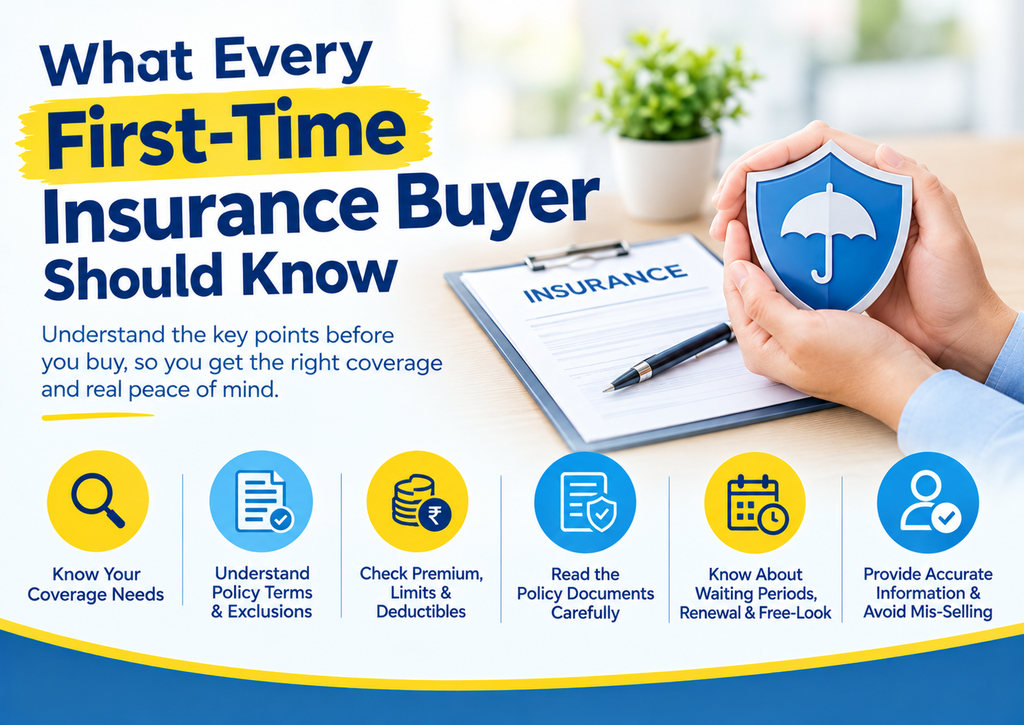
Understand What Type of Insurance You Need
Different insurance policies protect against different risks.
Life Insurance is primarily designed to provide financial protection against the risk of death and may also include other benefits depending on the product.
Health Insurance generally helps cover eligible medical and hospitalization expenses according to the policy terms.
Motor Insurance provides coverage related to insured vehicles and may include third-party liability and other sections depending on the policy.
Home and Property Insurance can cover specified risks affecting property and assets.
Travel Insurance may provide protection for specified travel-related risks such as medical emergencies, baggage-related losses, or trip cancellation, depending on the policy.
Choosing the right category is the starting point because a policy can only provide the protection specified in its contract.
Premium Is Not the Same as Coverage
A lower premium does not automatically mean better value, and a higher premium does not automatically mean broader protection.
Two policies may have similar premiums but very different:
- Sum insured or sum assured
- Coverage
- Exclusions
- Deductibles
- Sub-limits
- Waiting periods
- Add-ons or riders
- Policy conditions
The policy wording is therefore more important than looking at price alone.
Read the Policy Benefits and Coverage
Before buying, understand exactly what the policy is designed to cover.
For life insurance, this can include death benefits, maturity benefits, surrender benefits, riders, policy loans and other product-specific features. IRDAI’s life-insurance framework requires key product features to be presented in simple terms, along with a Customer Information Sheet (CIS).
For health insurance, the Customer Information Sheet includes important details such as the type of insurance, sum insured, coverage, exclusions, sub-limits, deductibles, waiting periods, renewal, portability and other policy features.
Pay Close Attention to Exclusions
An exclusion is something the policy does not cover.
Many insurance-related disputes arise because a buyer remembers the benefits discussed during the sale but does not examine what is excluded.
Depending on the product, exclusions may relate to particular conditions, activities, types of loss, treatments, circumstances, or other restrictions.
A policy should therefore be understood from both sides:
What is covered + What is not covered
Understand Waiting Periods and Deductibles
These terms are especially important in health insurance.
A waiting period means that certain specified conditions or treatments may not be covered during a defined period.
A deductible is a specified amount that the insurer does not pay and which may be borne by the policyholder before the insurer’s liability applies, depending on the policy structure. IRDAI’s health-insurance guidance explains these concepts and also sets out the role of the Customer Information Sheet.
First-time buyers should also pay attention to sub-limits, co-payments and room-rent or treatment-specific restrictions where applicable.
Give Accurate Information in the Proposal Form
The information provided while applying for insurance can be important to the insurer’s assessment of the risk.
Details such as age, occupation, health information, previous policies, claims history, assets, vehicle information or other relevant facts may vary depending on the type of insurance.
Providing incomplete or inaccurate information can create difficulties later, particularly when a claim is assessed.
IRDAI’s insurance-agent guidance has emphasized the importance of material information in proposals and prohibits inducing a prospect to omit material information or provide wrong information.
Do Not Rely Only on Verbal Promises
A verbal explanation during the sales process may not fully describe the legal terms of an insurance contract.
The policy document, schedule, proposal information, applicable illustrations, endorsements and other official documents are important records.
For life insurance, IRDAI requires benefit illustrations at the point of sale for applicable products, and the illustration forms part of the policy documentation.
When something is important to you, it is better to understand where that benefit or condition appears in the written policy documents.
Check the Customer Information Sheet
The Customer Information Sheet (CIS) is designed to explain basic policy features in simpler language.
For life insurance, IRDAI says the CIS should be provided with every policy and include information such as benefits, exclusions, free-look provisions and claims, servicing and grievance-redressal information.
IRDAI’s health-insurance guidance similarly describes the CIS as a document provided along with the policy document and lists key information it should contain.
For a first-time buyer, the CIS can be a useful starting point before reading the detailed policy wording.
Know the Free-Look Period
Certain insurance policies provide a Free-Look Period, during which the policyholder can review the policy terms and decide whether to continue.
For eligible policies with a term of one year or more, IRDAI’s current health-insurance guidance provides a 30-day free-look period from receipt of the policy document, subject to the applicable conditions. IRDAI’s life-insurance master circular also provides a 30-day period for reviewing policy terms.
The exact refund conditions and applicable deductions should be checked in the relevant policy and regulations.
Understand Renewal and Continuity
Insurance is often not a one-time purchase.
Health and general insurance policies commonly require timely renewal to maintain coverage and, where applicable, continuity-related benefits.
IRDAI explains that a health-insurance grace period allows premium payment after the due date for renewal without loss of certain continuity benefits, although coverage need not be available for the period for which no premium is received.
A first-time buyer should therefore understand the policy period, renewal date and consequences of missing renewal.
Keep Your Policy Documents Safe
Maintain copies of:
- Policy document
- Customer Information Sheet
- Proposal form
- Premium payment records
- Benefit illustration, where applicable
- Endorsements and policy updates
- Claim-related correspondence
Having these documents easily available can make future servicing and claim communication easier.
Understand Who Is Selling the Policy
Before purchasing, understand whether you are dealing directly with an insurer, an agent, broker, or another authorized distribution channel.
It is important to know which insurer is actually underwriting the policy and where official policy-related communication will come from.
IRDAI guidance for insurance agents includes identifying the insurer and providing relevant product information to prospects.
Insurance Should Match Your Actual Needs
The right insurance policy depends on the risk you are trying to protect against.
For example, a person looking for family financial protection may have different requirements from someone primarily concerned about hospitalization expenses, vehicle damage, property risks or business liabilities.
The important question is not simply:
“How much is the premium?”
It is:
“What protection am I actually getting for this premium?”
Be Careful About Mis-Selling
First-time buyers may be unfamiliar with insurance terminology and may rely heavily on explanations given during the sale.
Problems can arise when the policy is presented as offering benefits that are different from its actual terms, or when important conditions and exclusions are not properly understood.
Reading the written documents and comparing the actual policy features with what was represented during the sale can help reduce misunderstandings.
Final Thoughts
Buying your first insurance policy is an important financial decision. Understanding the policy before purchasing is just as important as paying the premium.
A first-time buyer should have a clear understanding of the coverage, exclusions, limits, waiting periods, deductibles, policy duration, renewal terms, claim provisions and important policy documents.
Insurance is a contractual product, so the written terms matter. Taking time to understand those terms can help prevent confusion and disputes later.
Need Help With an Insurance-Related Problem?
Insurance Resolve helps policyholders understand and address insurance-related concerns, including:
Insurance Mis-Selling | Claim Rejection | Claim Delay | Claim Short Settlement | Lapsed Policy Issues | Insurance Service Issues
📞 +91 9910352249
📧 help@insuranceresolve.com
🌐 www.insuranceresolve.com
Insurance Resolve – We Resolve. You Relax.

