
Insurance claims often involve several documents, and each document can serve a different purpose in helping the insurer understand the loss, treatment, damage, or circumstances involved. The documents required can vary depending on the type of insurance, the nature of the claim, and the terms of the policy.
Understanding insurance claim documents is important because documentation forms an important part of the claim assessment process. It also helps policyholders understand what information may be relevant when an insurer evaluates a claim.
What Are Insurance Claim Documents?
Insurance claim documents are records and supporting materials related to an insurance claim. They provide information about the policyholder, the insured event, the loss or expense, and the circumstances surrounding the claim.
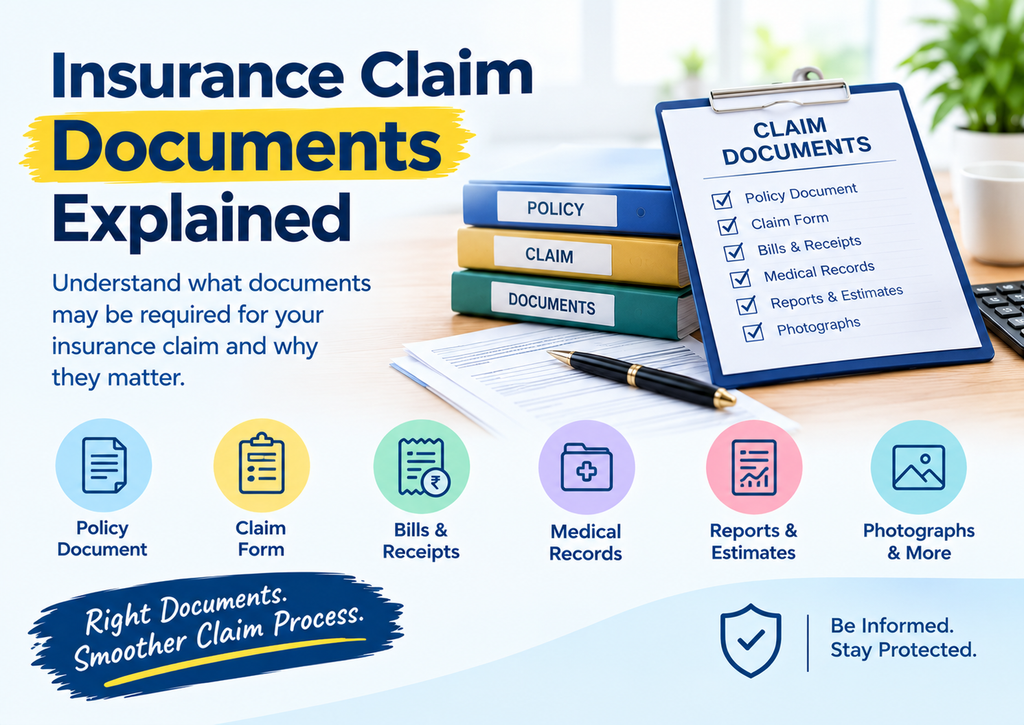
Depending on the type of insurance, these may include forms, bills, reports, receipts, photographs, medical records, repair estimates, policy documents, and other relevant records.
Why Are Documents Important in an Insurance Claim?
Insurance claims are generally assessed based on the information available to the insurer.
Documents can help establish:
- The identity of the policyholder
- The existence and validity of the policy
- The occurrence of the insured event
- The nature and extent of the loss
- The expenses associated with the loss
- The circumstances surrounding the claim
- Whether the claim falls within the policy coverage
The exact documents required depend on the policy and circumstances.
Common Documents Associated With Insurance Claims
1. Insurance Policy Document
The policy document contains important information about the insurance contract, including coverage, exclusions, limits, conditions, and other applicable terms.
It can be an important reference when determining whether a particular loss or expense falls within the policy.
2. Claim Form
A claim form generally contains information about the policyholder, the insured event, and the nature of the claim.
The information provided in the claim form can form part of the insurer’s assessment of the claim.
3. Proof of Identity
Depending on the insurance product and claim circumstances, identification or other verification documents may be required to establish the identity of the policyholder or claimant.
4. Bills and Receipts
Bills, invoices, receipts, and payment records can provide information about expenses associated with a covered loss.
For health insurance, these may include hospital bills and treatment-related expenses. For property or motor insurance, invoices and repair estimates may be relevant.
5. Medical Records
Health and life insurance claims may involve medical records such as prescriptions, diagnostic reports, discharge summaries, medical certificates, and other treatment-related information.
The specific medical documents required depend on the claim and the applicable policy conditions.
6. Police or Incident Reports
For certain claims involving accidents, theft, damage, or other incidents, a police report or incident report may be relevant.
Whether such documentation is required depends on the circumstances and policy requirements.
7. Photographs and Videos
Visual evidence can sometimes help establish the nature and extent of damage.
For example, photographs may be relevant to motor vehicle, property, marine, or other damage-related insurance claims.
8. Repair Estimates and Assessment Reports
For property and motor insurance claims, repair estimates, surveyor reports, inspection reports, or assessment documents may form part of the claim record.
These documents can provide information about the nature and estimated cost of the damage.
Documents Can Differ by Type of Insurance
There is no single set of documents applicable to every insurance claim.
Health Insurance
Health insurance claims may involve:
- Hospital bills
- Discharge summaries
- Prescriptions
- Diagnostic reports
- Medical records
- Pharmacy bills
- Claim forms
Motor Insurance
Motor insurance claims may involve:
- Policy documents
- Vehicle registration documents
- Driving licence
- Repair estimates
- Photographs of damage
- Accident or police reports where applicable
- Repair invoices
Life Insurance
Life insurance claims may involve:
- Policy documents
- Claim form
- Death certificate
- Medical records where relevant
- Nominee or claimant identification
- Other documents required under the policy
Property Insurance
Property claims may involve:
- Proof of ownership or interest
- Photographs of damage
- Repair estimates
- Purchase invoices
- Incident reports
- Survey or assessment reports
The requirements can vary considerably depending on the policy and circumstances.
Missing Documents and Claim Delays
Missing or incomplete documentation can sometimes lead to additional queries or delays in claim assessment.
An insurer may request further information when the available documents do not provide sufficient information to evaluate the claim.
However, a request for additional documents does not automatically mean that a claim will be rejected.
Incorrect Information Can Create Problems
The accuracy and consistency of information contained in claim documents can be important.
Differences between documents, incorrect information, incomplete disclosures, or inconsistencies regarding the circumstances of a loss may result in additional scrutiny or questions during claim assessment.
Documents Do Not Guarantee Claim Approval
Providing documents does not automatically mean that a claim will be approved.
An insurer generally assesses the claim against the policy’s coverage, exclusions, limits, conditions, and the circumstances of the insured event.
A claim may ultimately be approved, partially settled, delayed, or rejected depending on the applicable policy terms and facts.
Importance of Keeping Insurance Records
Maintaining copies of relevant insurance policies, receipts, reports, medical records, photographs, and other important records can provide a useful reference when an insurance matter arises.
Good record-keeping can also help policyholders better understand their coverage and the documentation associated with previous transactions or claims.
Conclusion
Insurance claim documents provide important information about the policy, insured event, loss, expenses, and circumstances of a claim. The exact documentation required depends on the type of insurance and the nature of the claim.
Understanding documents such as policy records, claim forms, bills, receipts, medical records, photographs, reports, and repair estimates can help policyholders better understand how insurance claims are evaluated.
Contact Insurance Resolve – Insurance Claim Documents
For assistance with insurance claim documents, claim disputes, claim rejection, claim delays, policy reviews, insurance mis-selling concerns, and other insurance-related matters:
📞 Call: 99103-52249
📧 Email: help@insuranceresolve.com
🌐 Website: www.insuranceresolve.com

