

Health insurance is designed to provide financial support for covered medical expenses, but coverage does not always begin for every treatment immediately after the policy starts.
Many health insurance policies contain waiting periods. A waiting period is a specified period during which certain diseases, treatments or situations may not be covered under the policy. IRDAI’s health-insurance guidance states that the maximum waiting period under health insurance policies is generally 36 months, including the waiting period for pre-existing diseases, subject to the applicable policy and regulatory framework.
Understanding waiting periods is important because they can affect whether a particular medical expense is payable when a claim is made.
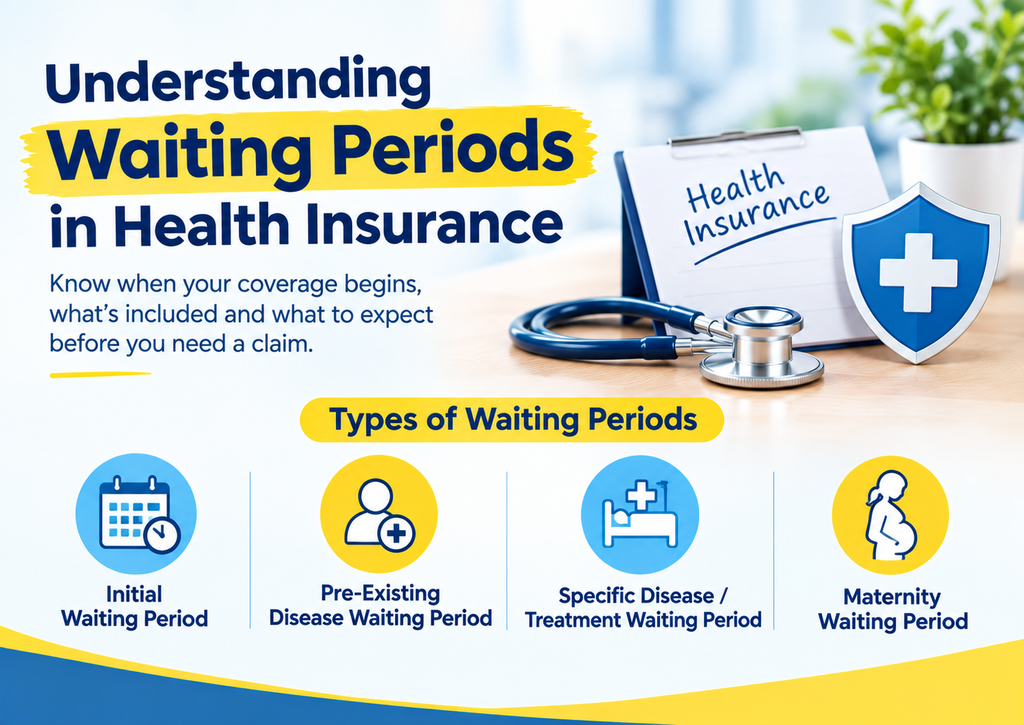
What Is a Waiting Period?
A waiting period is the time that must pass before specified coverage becomes available under a health insurance policy.
The waiting period does not necessarily mean that the entire health insurance policy is inactive. Instead, it usually applies to particular diseases, treatments, procedures or circumstances mentioned in the policy.
The exact waiting period depends on the policy terms.
Common Types of Waiting Periods
Initial Waiting Period
Many health insurance policies have an initial waiting period for illnesses.
IRDAI’s policyholder information states that a new health insurance policy generally has a 30-day waiting period from the policy inception date for illnesses, while hospitalization arising from an accident is generally not subject to this initial waiting period, subject to the policy terms.
This means that a policyholder should not automatically assume that every illness-related hospitalization will be covered immediately after purchasing a new policy.
Pre-Existing Disease Waiting Period
A pre-existing disease, or PED, refers to a medical condition that existed before the policy’s commencement according to the applicable definition.
Where a disclosed pre-existing disease is accepted for coverage, the policy may apply a waiting period before expenses relating to that condition become covered.
Under the current IRDAI health-insurance FAQ for the 2024 framework, the maximum waiting period is stated as 36 months.
The actual waiting period in a particular policy can be shorter, so the policy wording and Customer Information Sheet should always be checked.
Specific Disease or Treatment Waiting Period
Some policies impose waiting periods for specified diseases or procedures.
IRDAI describes a specific waiting period as a period, up to the applicable maximum, during which specified diseases or treatments may not be covered, subject to the policy terms. Examples mentioned in IRDAI’s guidance include conditions such as cataract and hernia.
These conditions can apply even when the disease or treatment was not pre-existing.
Maternity Waiting Period
Some health insurance policies have a separate waiting period for maternity-related benefits.
The duration and conditions vary by policy. Therefore, maternity coverage should not be assumed simply because a health insurance policy includes general hospitalization coverage.
The relevant policy wording should be checked for the applicable maternity waiting period, exclusions and eligibility conditions.
Waiting Period Is Different From an Exclusion
A waiting period and an exclusion are not the same thing.
Waiting period: A particular coverage may become available after the specified waiting period is completed, subject to the policy terms.
Exclusion: A particular treatment, condition or circumstance may be outside the scope of coverage altogether.
IRDAI describes exclusions as specific conditions, treatments, services or situations that are not covered under the policy.
Understanding this difference is important when reviewing health insurance coverage.
Why Waiting Periods Matter During Claims
A policyholder may have a valid health insurance policy and still find that a particular treatment is not payable because the applicable waiting period has not been completed.
For example, if a policy contains a specified waiting period for a particular procedure, treatment received before that period ends may not be covered, even though the overall policy remains active.
The claim outcome therefore depends on the specific policy terms and the circumstances of the claim.
What Happens After the Waiting Period?
Once the applicable waiting period has been completed, the relevant condition or treatment may become covered, provided the policy remains active and the other policy conditions are satisfied.
IRDAI explains that specified waiting periods can extend up to 36 months and that coverage applies after completion of the applicable period subject to continuous renewal without a break.
This is why maintaining continuity of health insurance can be important.
Waiting Periods and Policy Renewal
Renewing a health insurance policy on time can help preserve continuity benefits.
IRDAI advises policyholders to renew their health insurance on time because a break in coverage can affect continuity benefits relating to waiting periods and pre-existing diseases.
The applicable rules can also differ when a policyholder changes insurers through portability, so the policyholder should understand how previous coverage is being credited.
Waiting Periods and Portability
Health insurance portability can allow a policyholder to move from one insurer to another while carrying certain accrued benefits, subject to applicable regulations and the terms of the new policy.
This can be particularly relevant to waiting periods.
IRDAI’s health-insurance information provides specific timelines and requirements for portability and explains that continuity-related benefits can be relevant when moving between insurers.
Therefore, changing insurers does not necessarily mean that a policyholder has to start every waiting period from zero, but the exact treatment depends on the applicable portability rules, existing coverage and the new policy.
Customer Information Sheet and Waiting Periods
IRDAI requires a Customer Information Sheet (CIS) to be provided with health insurance policies.
The CIS is intended to explain important policy features in simple language. IRDAI states that the CIS should include details such as coverage, exclusions, sub-limits, deductibles and waiting periods.
This makes the CIS a useful document for understanding the key features of a health insurance policy.
Waiting Periods and Mis-Selling
Waiting periods can become a source of misunderstanding when policy benefits are explained without clearly discussing their limitations.
For example, a policyholder may understand that a particular treatment is covered but may not realize that a waiting period applies.
This is why policyholders should look beyond promotional descriptions and review the actual policy documents, CIS, exclusions and waiting-period provisions.
Important Things to Understand
Before relying on a health insurance policy, it is important to understand:
- Initial waiting period
- Pre-existing disease waiting period
- Specific disease or treatment waiting periods
- Maternity waiting period, where applicable
- Exclusions
- Deductibles
- Co-payment
- Sub-limits
- Policy continuity requirements
- Portability provisions
IRDAI specifically advises policyholders to pay attention to waiting periods, exclusions, room-rent and ICU limits, sub-limits and co-payment while understanding health insurance products.
Final Thoughts
Waiting periods are an important part of health insurance coverage. They determine when certain diseases, treatments or benefits become available under the policy.
A health insurance policy should therefore be understood not only by its sum insured and premium, but also by its waiting periods, exclusions, conditions and continuity provisions.
Understanding these terms before a medical need arises can help policyholders have clearer expectations about their coverage.
Insurance Resolve
Insurance Resolve helps policyholders understand and address insurance-related concerns, including:
- Health Insurance Claim Issues
- Claim Rejection
- Claim Delay
- Claim Short Settlement
- Insurance Mis-Selling
- Policy Service Issues
- Other Insurance-Related Problems
📞 +91 9910352249
📧 help@insuranceresolve.com
🌐 www.insuranceresolve.com
Insurance Resolve – We Resolve. You Relax.

